
A decade after Brexit, UK voters reflect on break from EU
Clip: 6/23/2026 | 8m 32sVideo has Closed Captions
A decade after Brexit, UK voters reflect on decision to break from European Union
Tuesday marks the 10th anniversary of the most divisive day in Britain’s recent history: Brexit, the vote to leave the European Union. Voters were promised a Britain free of European laws, decreased immigration, and a major boost to business, without the EU’s economic constraints. But as Malcolm Brabant reports, leave and remain voters have one thing in common. They’re not celebrating.
Problems playing video? | Closed Captioning Feedback
Problems playing video? | Closed Captioning Feedback
Major corporate funding for the PBS News Hour is provided by BDO, BNSF, Consumer Cellular, American Cruise Lines, and Raymond James. Funding for the PBS NewsHour Weekend is provided by...
A decade after Brexit, UK voters reflect on break from EU
Clip: 6/23/2026 | 8m 32sVideo has Closed Captions
Tuesday marks the 10th anniversary of the most divisive day in Britain’s recent history: Brexit, the vote to leave the European Union. Voters were promised a Britain free of European laws, decreased immigration, and a major boost to business, without the EU’s economic constraints. But as Malcolm Brabant reports, leave and remain voters have one thing in common. They’re not celebrating.
Problems playing video? | Closed Captioning Feedback
Where to Watch PBS News Hour
PBS News Hour is available to stream on pbs.org and the PBS app.
Providing Support for PBS.org
Learn Moreabout PBS online sponsorshipGEOFF BENNETT: Today is the 10th anniversary of the most divisive day in Britain's recent history, Brexit, its vote to leave the European Union.
Voters were promised a Britain free of European laws, decreased immigration, and a major boost to business without the E.U.
's economic constraints.
But, as Malcolm Brabant reports from Blackpool in the northwest of England, leave and remain voters have one thing in common.
They're not celebrating.
MALCOLM BRABANT: June 2016, when Britain was split almost right down the middle, as 52 percent of the country demanded a divorce from the European Union.
MAN: I believe England's better off by itself because we have the drive and tenacity to make up for any of the so-called benefits.
WOMAN: Out.
Definitely out.
QUESTION: Out.
OK, do you want to talk about it?
WOMAN: Shut that bloody tunnel up, Mike.
WOMAN: There's too many of them.
They're taking over, literally, our houses, our jobs, literally taking over.
NIGEL FARAGE, Reform Party Leader: Let June the 23rd go down in our history as our independence day.
(CHEERING) MALCOLM BRABANT: But one decade later, no one is cheering, especially in Blackpool, once Britain's leading seaside resort, whose residents distinguished themselves by generating the biggest pro-Brexit vote in Northwestern England.
MAN: We should never have left, to be honest with you.
The world's gone to pot, really.
I just got a feeling that we shouldn't have left.
We should go back into it.
WOMAN: For a long time now, ever since this change, I think we have gone downhill.
Britain has totally gone downhill.
Everything is overexpensive.
It's absolutely crazy.
MALCOLM BRABANT: Ten years after the referendum, Britain remains a painfully disunited kingdom, and a significant number of Brexit voters regret their decision on that day.
One of Britain's leading polling companies says that 56 percent of the electorate would vote to rejoin the European Union if given a chance.
And that includes 22 percent of those who voted leave.
Rob Benson is full of regret.
Like so many post-Brexit, Benson's business lost access to European markets, as the E.U.
punished Britain with a swathe of bureaucratic obstacles.
In these sandy shores north of Blackpool, Benson farmed shellfish, popular in Spain and France, generating $4 million a year.
But after Brexit, the enterprise collapsed.
ROB BENSON, Kingfisher Seafoods: I actually voted to leave, but, obviously, we were never told the truth as to what the consequences were going to be.
And now the consequences are out, it's too late.
MALCOLM BRABANT: How angry are you?
ROB BENSON: Very.
Oh, yes, very angry.
It's totally destroyed our business.
MALCOLM BRABANT: The abiding face of Brexit is Nigel Farage, whose uncompromising campaign against the European Union catalyzed the referendum.
NIGEL FARAGE: It was about getting back control of our country, getting back control of our borders.
They have given us record levels of immigration.
We are literally living through a population explosion.
MALCOLM BRABANT: History will also judge Boris Johnson's short-lived premiership as the driving force behind the legislation delivering Brexit.
Now a newspaper columnist, Johnson is toasting Brexit's anniversary.
BORIS JOHNSON, Former British Prime Minister: Evening everybody; 10 years after that historic Brexit referendum, I feel more convinced than ever that the British people were heroic and magnificent and did the right thing in voting for freedom and democratic independence.
ROB BENSON: I think prison is too good for them, to be truthful, because they just -- they just lied.
MALCOLM BRABANT: According to the Confederation of British Industry, the nation's economy has shrunk by about 8 percent since Brexit was enshrined in law.
When we visited this northwest cheese factory before Brexit was sealed, the owners exported to 40 different countries and hoped to expand.
But the business went bust, and 30 people lost their jobs, thanks in no small part to the imposition of European tariffs.
Henri Murison is chief executive of a lobbying group called the Northern Powerhouse Partnership.
HENRI MURISON, CEO, Northern Powerhouse Partnership: The economic evidence is pretty clear that our businesses have suffered from lack of access to European markets.
So having left the single operating economic model of the European Union, we now have more barriers to trade, and that has definitely held back businesses here.
DIMITRIS PAPADIMITRIOU, Professor of Political Science, University of Manchester: Brexit has been a tremendous act of self-harm.
MALCOLM BRABANT: Political scientist Dimitris Papadimitriou is a vice dean of Manchester University.
DIMITRIS PAPADIMITRIOU: The political and economic turmoil that has ensued has definitely made people feel that Britain is not a first-class power anymore.
MALCOLM BRABANT: For Europhiles, Blackpool embodies a self-inflicted wound, especially as it's one of Britain's most poverty-stricken boroughs, as the graffiti says, dreaming of better days.
Brexit deprived the town of European funds intended to boost its economy by, for example, restoring Blackpool's tribute to the Eiffel Tower and smartening up a seafront that lures millions each year.
LYNN WILLIAMS, Leader, Blackpool Council: That type of work costs an absolute fortune.
So to lose access to that funding was a real major blow for us.
And, as a consequence, we're only now, 10 years on, starting the other necessary works to the promenade and the seafront.
MALCOLM BRABANT: Lynn Williams of Britain's governing Labor Party heads Blackpool Council.
She's striving to secure government grants to replace lost European funding.
Blackpool's money troubles were exacerbated by lockdowns during the COVID pandemic.
And Williams believes that the trickle-down of economic hardship has fueled the rise of right-wing politicians.
LYNN WILLIAMS: That was the start, really, of that kind of populist politics of, we have to leave, we have to be an island.
PROTESTERS: We want our country back!
LYNN WILLIAMS: Ten years on, we are now seeing this particular rise of that type of politics, which is -- I think is a direct consequence of Brexit.
MALCOLM BRABANT: Lynn Williams' barb is aimed at the politics of Mark Butcher, a foot soldier of Nigel Farage's right-wing anti-immigrant reform party.
Butcher runs a soup kitchen for Blackpool's poorest, including homeless military veterans, whom he says are treated worse than illegal immigrants.
MARK BUTCHER, Parliamentary Candidate, Reform U.K.
: We never really got Brexit in the first place, so it was a betrayal from the Conservative Party.
They didn't deliver the Brexit that we signed up for.
MALCOLM BRABANT: And Butcher fears that, 10 years on, Brexit is still insecure.
MARK BUTCHER: They're now wanting to get us back into Europe, completely ignoring the 17.4 million people that we wanted out.
And out meant out meant out.
MALCOLM BRABANT: Regretful leave voter rob Benson survived his shellfish company's Brexit-induced collapse by servicing offshore wind farms instead.
In the marina where he moors his new boat, there's a mockup of the Titanic.
Benson likens Brexit to an iceberg and hopes that growing aspirations to reconcile with Europe will gain traction.
ROB BENSON: I'd love to rejoin, because, if we rejoined, we have had a taste of what it's like trying to do it without.
It doesn't work, not for us.
It really doesn't.
MALCOLM BRABANT: To the dismay of Brexiteers, the Labor government has been working to repair ties with the E.U.
But following yesterday's resignation of Prime Minister Keir Starmer, it's unclear just how much closer Britain and Europe will become.
MAN: We now come to Andy Burnham, member from Makerfield.
MALCOLM BRABANT: Newly reelected M.P.
Andy Burnham, who's expected to succeed Starmer, is vague on what kind of relationship he wants.
But Burnham has been explicit about ending the divide between England's richer south and poorer north.
And that's good news for this seaside resort.
For the "PBS News Hour," I'm Malcolm Brabant in Blackpool.
Book documents war experience for Ukraine’s LGBTQ+ community
Video has Closed Captions
'The Queer Face of War' chronicles hardships for Ukraine’s LGBTQ+ community during war (4m 42s)
Farmers struggle as shifting weather patterns disrupt crops
Video has Closed Captions
Farmers struggle with crops as climate change makes weather less predictable (7m 45s)
How the federal student loan changes could impact borrowers
Video has Closed Captions
How the federal student loan changes could impact borrowers (6m 52s)
Moniz breaks down challenges of nuclear talks with Iran
Video has Closed Captions
Ex-Energy Secretary Moniz breaks down challenges of nuclear negotiations with Iran (8m 29s)
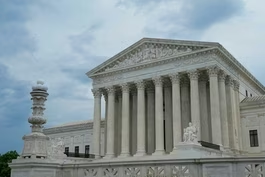
News Wrap: SCOTUS sides with Trump in deportation case
Video has Closed Captions
News Wrap: Supreme Court sides with Trump administration in deportations case (4m 26s)
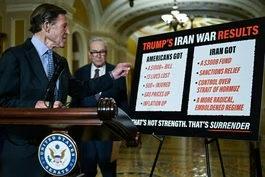
Senate votes to limit Trump’s war powers in Iran
Video has Closed Captions
In rare rebuke, Senate votes to limit Trump’s war powers in Iran (6m 27s)
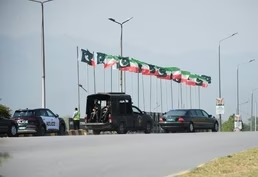
U.S. and Iran at odds over nuclear inspections
Video has Closed Captions
U.S. and Iran at odds over nuclear inspections, Strait of Hormuz fees (4m 7s)
Providing Support for PBS.org
Learn Moreabout PBS online sponsorship
- News and Public Affairs

FRONTLINE is investigative journalism that questions, explains and changes our world.
 New Episode
- News and Public Affairs

Today's top journalists discuss Washington's current political events and public affairs.


 New Episode
 New Episode
 New Episode
 New Episode
 New Episode
 New Episode
Support for PBS provided by:
Major corporate funding for the PBS News Hour is provided by BDO, BNSF, Consumer Cellular, American Cruise Lines, and Raymond James. Funding for the PBS NewsHour Weekend is provided by...