
Trump’s Ukraine U-turn
Clip: 10/16/2026 | 13m 50sVideo has Closed Captions
Trump’s Ukraine U-turn
There was another dramatic U-turn in President Trump's attitude toward Ukraine and Russia. Last week, he agreed to a billion-dollar diesel deal with Russia, giving Vladimir Putin money when he needs it. Trump also spent this week deriding Ukrainian President Zelenskyy. The panel discusses what's happening and what it means.
Problems playing video? | Closed Captioning Feedback
Problems playing video? | Closed Captioning Feedback
Major funding for “Washington Week with The Atlantic” is provided by Consumer Cellular, Otsuka, Kaiser Permanente, the Yuen Foundation, and the Corporation for Public Broadcasting.
Trump’s Ukraine U-turn
Clip: 10/16/2026 | 13m 50sVideo has Closed Captions
There was another dramatic U-turn in President Trump's attitude toward Ukraine and Russia. Last week, he agreed to a billion-dollar diesel deal with Russia, giving Vladimir Putin money when he needs it. Trump also spent this week deriding Ukrainian President Zelenskyy. The panel discusses what's happening and what it means.
Problems playing video? | Closed Captioning Feedback
Where to Watch Washington Week with The Atlantic
Washington Week with The Atlantic is available to stream on pbs.org and the PBS app.
Buy Now
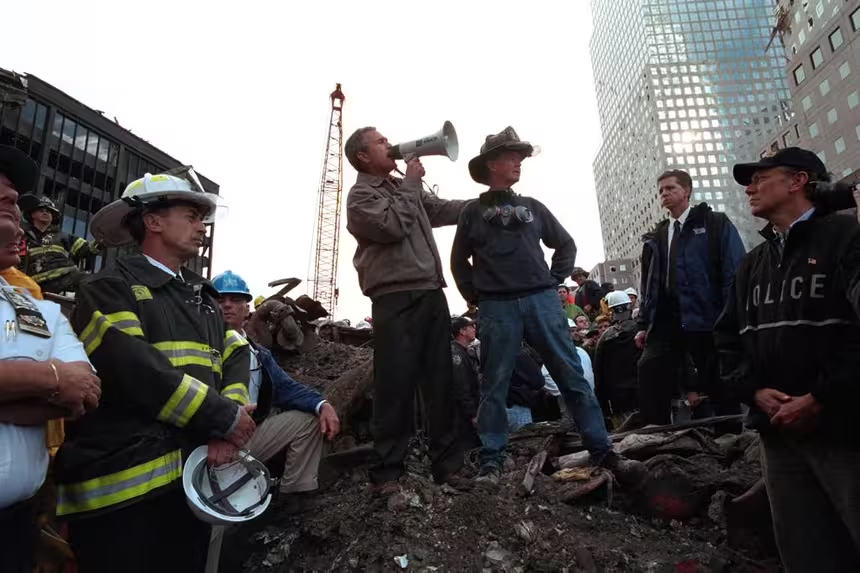
10 big stories Washington Week covered
Washington Week came on the air February 23, 1967. In the 50 years that followed, we covered a lot of history-making events. Read up on 10 of the biggest stories Washington Week covered in its first 50 years.Providing Support for PBS.org
Learn Moreabout PBS online sponsorshipGood evening and welcome to Washington Week.
We're coming to you tonight from Austin PBS in front of a live studio audience.
Early voting begins here in Texas on Monday, and the outcome of the race between State Representative James Talerico and Attorney General Ken Paxton could determine which party controls the Senate in the final two years of Donald Trump's presidency.
The biggest questions are on the table tonight.
Is there a blue wave coming?
What would the Democrats do if they managed to take control of one or both chambers of Congress?
And how will Donald Trump rule in the last two years of his presidency?
Should he find himself living down the street from a Democratic controlled capital?
There's an even more immediate question before the country.
Will Trump or his supporters challenge the election results in conventional or unconventionally dangerous ways should they lose the House or the Senate?
And there's one more question.
I call it the the World War III question.
How will Donald Trump manage a destabilized world, one in which America's support for its allies can no longer be assumed?
We have a great panel to discuss all of this tonight.
Mark Leovich is a staff writer at The Atlantic and the author of, among other bestsellers, This Town.
He is a former reporter for the New York Times and the Washington Post and is known as the foremost anthropologist of Washington.
Ashley Parker covers the White House for the Atlantic and is a multiple Pulitzer Prize winner.
She previously served as White House bureau chief for the Washington Post.
Vivian Salama covers national security for the Atlantic and previously covered global affairs in the White House for the Wall Street Journal.
And Evan Smith is the managing director for events at the Atlantic and also hosts Overheard on PBS right here in this studio.
He is the founding editor of the Texas Tribune and he's something of a local legend.
Thank you all for and he's the next governor of Texas, right?
Yeah.
Yeah.
Yeah.
Um you haven't announced yet, but we're just I'm just assuming that the the early polls are are good.
Evan, thank you for being here and hosting us in your in your home studio.
We're very glad to be um with uh such a great audience.
Um we have a lot to get to tonight.
Uh, and before we talk about the midterms, um, I, you know, the world intrudes as it tends to do.
We just saw a dramatic Uturn.
I guess it's another dramatic U-turn in President Trump's attitude toward Ukraine and and Russia.
Last week, he decided to buy billions of dollars in diesel from Russia, which makes Putin much richer at a time when he needs the money.
Um, and President Trump has spent the week uh deriding uh President Zalinski.
of Ukraine.
He told uh an interviewer this week that he feels uh well, this is Zilinsky talking about Trump, that he feels betrayed by the powering down of Starlink, that's the um uh communications that that that that uh we've been using.
Um and he feels betrayed by the diesel deal.
And he said, quote, "It's a pity that we're losing a strong partner."
I was really struck by how final that sounds.
But Vivian, give us a a sense of what's happening, why it's happening, and what it means.
Oh, well, there's a difficult question.
Um, but I will try.
So, and you have 12 seconds.
And I have exactly 12 seconds.
I, you know, President Trump has never shied away from the fact that he's been skeptical of Ukraine, its leadership, and this dates back to his first term.
Remember, in the first term, you had the so-called perfect call with Zalinski when he first took office that ultimately led to the first impeachment because he asked President Zilinski to uh investigate his political rivals.
And so, you know, since then, President Trump has sort of had a grievance.
He also has an affinity for Vladimir Putin.
He likes the way that he runs his country.
It's sort of this all powerful way where he can kind of um you know put down journalists and political dissident and kind of rule with an iron fist and it has been very appealing to him.
He sees him as a strong man and that's something that appeals to him.
And so when Russia launched its war first of all it's a full-scale invasion of Ukraine in 2022.
President Trump a insisted that that would have never happened on his watch that Putin respects him too much to have done that.
But then secondly, he also decided that he would resolve this conflict overnight.
He hasn't managed to do that and he sort of tried partially because he had a lot of people around him pushing him in the direction of Ukraine.
Ukraine is an ally.
It's, you know, the doorstep of Europe.
You have to help.
And so he's entertained that idea for the first year of his presidency.
But over time, he um increasingly believed that the only guy he needed to talk to, the only guy who matters in this is Vladimir Putin, right?
Because he's more powerful.
He's the one who's going to change things.
And so, he's really kind of leaned in on that and as a result has come a price for Ukraine, both in terms of the deals he is making with Russia and the deals he is willing to kind of pull back on with Ukraine.
Yeah.
Ashley, you you have a PhD in Trump's behavioral patterns.
um UT Austin I think right.
Yeah.
Yeah.
Um and the question is is we we periodically go through these phases where he seems supportive of Zalinski, but from your perspective, does Trump ever change?
In other words, the the the the the impulses that he has seem to there's a a little bit of a sign curve, a roller coaster maybe, but he always comes back to the same ideas.
Yeah.
On his c I mean there's a sense that Donald Trump is not particularly ideological which is both true and not true.
Um which is to say that on his core set of beliefs he's sort of frozen in amber in the 1980s and the views he held then being hardline and kind of nivist on immigration um the views he had on trade frankly the views he had on Iran.
Um those are very unchangeable.
um you know in the margins he is often swayed by charismatic personalities by what he last saw on TV by the last person to call him on the phone or leave the Oval Office but on these big things he fundamentally doesn't change um which when it comes to geopolitics one of the things as Vivian just mentioned that he likes he likes strong men he likes strength and power when he was first elected to the presidency he thought that it was a bit more like a monarchy right he was kind of genuinely ly befuddled that Congress had to sign off on on laws and he couldn't just dictate these things.
Um and so I think Congress might be befuddled about that.
Yeah.
Everyone's deeply confused.
Yeah.
Um and and so at the end of the day, he sort of believes as as he said famously in that Oval Office blow up that Zilinsky doesn't have the card.
Zilinsky is operating from the weaker position and Trump who is desperate, desperate, desperate for a Nobel Peace Prize and wants this deal.
In his ideal view, he he would get the deal by Zalinski just capitulating with his quote unquote mediocre cards.
One question before I go to Mark on a on a question about history.
When you you talk about these patterns being set in the 1980s, I'm not asking this as a joke, but what was the key year?
Was it 79 the Iran hostage?
No.
Because it's really remarkable that there's that there's this level of multi-deade consistency in his views.
What he thought about Iran in 1979 is what he thinks today.
What he thought about trade in 1982 is what he thinks today.
Was there like a was there a moment when something coalesed in him where he developed his worldview?
I mean, I can't pinpoint it to a particular year or a particular month that that would make a great oral history, but I you could just say June 13th, 1981 and I'd believe you, you know, but but I I would say kind of the 80s as he's coming up as a you know, the the boy uh from the outer burrow made good.
I mean, even some of those other things are still there within him.
And these are not policy things, but there was this sense that he had finally gotten to Manhattan.
Um but he was not taken seriously by the he was sort of gouch and and a little crude and even that sense of outsiderness is something in the chip on his shoulder that you see I mean a that's how he relates to his base in certain ways but it's something that that is still with him.
I mean people joke or half say seriously that maybe one of the reasons he ran for the presidency was because he was so embarrassed by Barack Obama at the White House correspondence dinner.
who you know who knows if that's an origin story but it does get to those those pathologies that were formed as some of us were there and Trump did not look happy at that that moment actually the uh Mark let me ask you this about Trump and Trumpism um it's a a very deliberately oversimplified question but is there anyone in American politics like Trump in his ability to just sort plowed through uh things uh phenomenon that that would that would sink any other political leader.
Oh, not not even close.
No, I mean I think that we've seen this again and again.
I mean, you know, in many categories, one being things that other politicians would end their career.
Um, you know, we've seen from from the beginning.
I mean, that doesn't apply to Donald Trump.
And I I think that that's going to inform the the very messy I think succession to him in the Republican party because you know JD Vance whoever you know tries to be the air parent is going to find that those rules do not apply to him or her.
And I think so that well go back it's the almost the the the 10th anniversary of Trump's first term in office.
go back and and with everything that you know now, what are the qualities of Donald Trump that made him this unique uh gravitydefying candidate?
I mean, I think one of the superpowers is just the shamelessness, just his inability to be uh sort of confined by the rules of embarrassment, by the room, the rules of norms, by the rules of, you know, what will history think of me?
I mean I remember during the end of his first term uh there was all this kind of polyianish talk about well Mr.
President don't you worry about how you'll be remembered in history and he like and others around him like you know Rudy Giuliani and others would say no I'll be dead or you know I'll be remembered as a loser.
I mean it was very black and white but but it's also very much I mean you you do realize that the check and balance of the White House begins with the conscience and the character of the president him or herself.
Right.
Right.
Right.
Um, before we before we jump and we'll talk about the Trump legacy a little bit and before we jump to Texas and and national politics, I want to ask one more question about some news of this week.
Vivian, you've been covering uh the controversy over uh the execution of Nidal Hassan, the convicted terrorist who uh carried out the Fort Hood u massacre.
Pete Hexet, the secretary of defense, wanted to televise that execution.
That was too much for Donald Trump.
He just uh said no to that.
Can you tell us what happened inside the White House?
So Pete Hags, that sort of surprised everyone, including people at the White House when he came out and he had not cleared that with with President Trump.
Well, that the the people that we talked to, the sources we talked to say that they were blindsided by it.
And even if he did consult with President Trump, um he may have sort of processed the idea that there was going to be a firing squad um execution, but not that it was going to be televised with the president, that that didn't really kind of sink in.
And so when the president sort of realized it, partly because Pete Hagath announced it last week, um he was taken aback.
He was getting t he was inundated by calls including from Republicans, including even from people in his inner circle.
um Speaker Mike Johnson very um wary about the whole idea and this concept of you know a public execution of a parapolgic um an old man who was a parapolgic just did not sit well with the president and of course people even though the paraplegic was a mass murderer even though the parapolgic was a mass murderer and eventually when the president revealed that he would uh pull back on this live streaming he you know started with the idea that this man is a terrorist and deserves to eye in his view, but live streaming it will not happen.
This obviously raises questions about Pete Heg, Seth.
Uh it it it also raises questions about about his management of the Department of Defense.
It also raises questions about his future political judgment.
I mean, he is one of many people.
We obviously have Marco Rubio and JD Vance in the in the first two just conventional wisdom says that they're the two most likely nominees at the moment.
But Hegathth is has uh expressed a great deal of interest in electoral politics.
Does this hurt Hegathth either in his current role or in his future?
I mean, there's been so many episodes in which Pete Hexath has sort of um you know, kind of hit rock bottom and then somehow, you know, Yes, I'm aware of that.
I was involved in that.
There you go.
Um and somehow he he comes back from it in part because he almost knows how to speak President Trump's language.
He's very good at sort of putting himself out there on television and making these sort of campy videos with of show shows of military bravado and insulting the performance parts and insulting journalists and things like that.
And that resonates with the president even if literally everyone around the president kind of soured on him at one point or another.
Um, and that's been pretty consistent.
President Trump for some reason has just continuously believed that he is effective in part because he takes orders.
 New
NewIs a blue wave coming, and how will Trump react?
Video has Closed Captions
Is a blue wave coming – and how will Trump react? (22m 46s)
 New
NewWho will emerge as the GOP's 2028 nominee?
Video has Closed Captions
Who will emerge as the GOP's 2028 nominee? (16m 18s)
Providing Support for PBS.org
Learn Moreabout PBS online sponsorship New Episode
- News and Public Affairs

Top journalists deliver compelling original analysis of the hour's headlines.
 New Episode
- News and Public Affairs

FRONTLINE is investigative journalism that questions, explains and changes our world.

 New Episode
 New Episode
 New Episode


 New Episode


 New Episode
Support for PBS provided by:
Major funding for “Washington Week with The Atlantic” is provided by Consumer Cellular, Otsuka, Kaiser Permanente, the Yuen Foundation, and the Corporation for Public Broadcasting.