
Coastal Maine Botanical Gardens, Hour 2
Season 30 Episode 8 | 52m 24sVideo has Closed Captions
Surprising treasures are in bloom during ROADSHOW’s fruitful journey in Boothbay, Maine.
Surprising treasures are in bloom during ROADSHOW’s garden journey in Boothbay, ME. One fruitful discovery stuns with a value reaching $70K!
Problems playing video? | Closed Captioning Feedback
Problems playing video? | Closed Captioning Feedback
Funding for ANTIQUES ROADSHOW is provided by Ancestry and American Cruise Lines. Additional funding is provided by public television viewers.
Support provided by:


Coastal Maine Botanical Gardens, Hour 2
Season 30 Episode 8 | 52m 24sVideo has Closed Captions
Surprising treasures are in bloom during ROADSHOW’s garden journey in Boothbay, ME. One fruitful discovery stuns with a value reaching $70K!
Problems playing video? | Closed Captioning Feedback
How to Watch Antiques Roadshow
Antiques Roadshow is available to stream on pbs.org and the free PBS App, available on iPhone, Apple TV, Android TV, Android smartphones, Amazon Fire TV, Amazon Fire Tablet, Roku, Samsung Smart TV, and Vizio.
Buy Now

ANTIQUES ROADSHOW's 2026 Production Tour
Enter now for a chance to win a pair of free tickets to one of the three stops on ANTIQUES ROADSHOW's 2026 Tour. Sweepstakes entry deadline is April 6.Providing Support for PBS.org
Learn Moreabout PBS online sponsorship♪ ♪ CORAL PEÑA: "Antiques Roadshow" is discovering the treasures of the Pine Tree State at Coastal Maine Botanical Gardens.
I can probably only count about five examples that I know of.
Really?
Whoa-ho!
(laughs, sniffles) You got me.
(laughing) ♪ ♪ PEÑA: Coastal Maine Botanical Gardens, where "Roadshow" is set up today, officially opened in 2007 after a grassroots effort led by visionary local citizens saw an opportunity to highlight the biodiversity of their coastal habitat.
325 acres of land is now dedicated to the wild and wonderful range of plant life in the region, including 19 acres of cultivated gardens.
As you can see, "Roadshow" has cultivated a growing interest in the treasures of Maine.
He was given to my father in 1910... Okay.
...on my father's first birthday.
He is an early Steiff mohair bear.
He also has a mechanism inside.
He does.
The mechanism is still working.
I can hear it winding up in there.
Mm-hmm.
Normally, he would somersault, but he's had a hard day getting here in the rain.
Yes, he has.
If he was just a teddy bear, I would put him at about $900 to $1,500.
Mm-hmm.
As the somersault bear, you're at the $1,500 to probably $3,000.
Okay.
A lot of these guys at this age don't work.
GUEST: My sister and I recently inherited some jewelry from my mom.
Her grandparents and great-grandparents had a lot of jewelry.
This piece just kind of caught my eye, I thought it was different.
Where were they from?
Originally from England, but then lived in Manhattan.
I love the design of this.
It's just so beautifully perfect.
It's like a North Star, the shape.
It's very simple.
It's platinum.
It has old European cut diamonds.
What you notice about it most are what?
The pink pearls.
So, pink, and what else?
And, and the blue.
And the blue, and the white.
Yeah.
These are natural pearls.
Okay.
This is truly a gemstone of the sea.
Most likely from places like the Persian Gulf.
Natural pearls in white, the bigger they get, the more expensive they are.
But they're a little more common, and I love the fact that they're here.
But two matched pink ones?
Wow.
And that's nature at its best.
And I guarantee you they didn't find two matched pink ones together.
It may have been years before somebody matched those up.
And then the one in the middle.
You know, you see a lot of black ones.
You see ones that are dark, they're gray.
We're out here, and it's not even sunny out, and you see the blue hues?
I mean, it's fabulous.
And then we turn it around, and there's a pin.
So this would've been worn as a pin, which was very common back then.
You pull the pin out and this bail flips up.
This is so you can slim what most likely would've been a thin platinum chain.
You can see the cups, how they took the time, probably an extra day in production or two, to sit there and engrave them, for something that almost nobody's gonna see.
It's probably around 1920.
Okay.
Yet it's so contemporary.
I love that-- when jewelry's kind of evergreen, then it just, it's always right.
I really, truly thought that this piece would have a signature, it's that fabulous.
No idea who...?
No idea who made it.
(chuckles) Natural pearls, being what they are, are, are worth more than regular, cultured pearls.
Okay.
In these hues, they're kind of special.
The center pearl, that, that beautiful bluish, silvery gray, is seven-and-a-half millimeters.
That's a nice size.
Auction price today would probably be $10,000 to $15,000.
(sputters, laughs) Oh, that's pretty good.
(laughing) (laughing) Yeah, wow.
A little bit more than, uh, than I thought.
I thought nothing, but, yeah, that's, that's amazing.
A retail price would probably be all of $25,000.
Wow, wow.
(laughs) Wow, that's amazing.
You and your sister are gonna have to share it.
We're gonna have to fight over it.
(both laughing) Oh, you're gonna fight over it.
I said share, not fight!
We'll share it, we'll share it.
(laughing) We'll take turns.
GUEST: We renovated a family home a couple of years ago and actually found this in the roofing.
We could see it through the roofing, and we stripped the roof just to get this out.
There was a dance hall in our home, and so they had a lot of advertising memorabilia there.
This is a vintage alpenstock.
It's made by a company in Italy called Stubai.
You can see the height of this, which made it a lot easier to traverse the rocks and the glaciers.
And if you had to, you could sit on it, to rest yourself when you're on a steep incline.
I'm sure it has a lot of history to it and been in a lot of mountains, just like me.
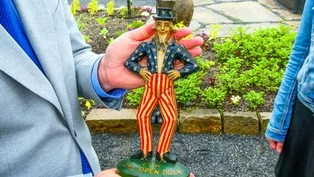
(chuckles) I brought in an Uncle Sam doorstop.
It's really heavy.
(chuckles) And it says "For the Open Door Policy," which, I'm not sure what that was, but it was my grandmother's, and it's been handed down for generations, and now it's mine.
And I was always told, "Don't get rid of Uncle Sam.
He's really important, he's a really unique piece."
And I don't know, really, much about him.
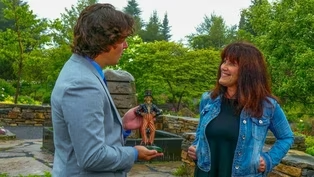
So what we have is a cast-iron doorstop, a figural doorstop, uh, created to hold a door open.
It's hand-painted.
It's circa 1910 to 1920, American-made, but we don't know exactly where.
Most likely New England or possibly the Midwest.
That's where a lot of the cast-iron foundries who would make sad irons, doorstops, and toy novelties were located.
The base here, it's really cute.
It's a nice play on words, "For the Open Door."
The Open Door was a political policy with the superpowers or the powers-that-be at around 1899, 1900, relative to trade and tariff interactions in China.
Oh.
Uncle Sam, obviously, this proud, dapper figure here, uh, represented the United States.
We were the ones that suggested that this policy of the Open Door in, in China at the time.
We'll turn it around to show the back half here.
So, this is the flat side that would be against the door.
Now, when I first saw it, it struck me because of the overall condition, uh, which is exceptional.
Mm-hmm.
These turn up unpainted sometimes.
Mm-hmm.
But finding one that's painted in authentic paint, uh, is quite rare.
Oh, I missed that.
I can probably count, I pro, I can probably only count about five examples that I know of.
Really?
Which would probably make this the second-rarest doorstop in existence.
Oh, stop it!
Seriously?
Seriously.
(gasps) Oh, my gosh.
(laughing) Uh, the things that I'll look for... Okay.
The things that I'll look for... Wow.
...is the crazing in the paint.
It's almost like an alligatoring or a crackling in the paint.
We can see it here.
That's a good sign-- that shows old paint.
One of the tools that we use when determining if the paint is original is a bl, a shortwave black-light U.V.
So it goes into the spectrum.
It's hard to see in open light here, but the way this lights is exactly what we want to see.
Nothing's really jumping out to suggest that the paint is tampered with or has been modified, restored, et cetera.
When I brought it up here, I did chip a little paint off of it... Okay.
...and it came off really easily.
We definitely want to avoid any more chips.
(chuckles) Uh, actually, the rule in my household growing up was, treat every chip like it's $1,000.
(gasps) Okay.
The other rule of thumb that we've used is that the money's in the face, and his face is in great shape.
Oh, okay.
A conservative auction estimate would be from $10,000 to $15,000.
Mm, wow.
Okay.
And the... Go, Uncle Sam.
(both laugh) And the top price, uh, actually exceeded $20,000 on one that sold at auction before.
Oh, my gosh!
Wow.
Wow-- thank you so much, that's... I can't even believe that, wow.
SARAH CALLAN: The children's garden is a really magical place where kids can engage all of their senses.
The garden is themed around storybooks written by Maine authors and illustrators.
When you enter the garden, you're greeted by a group of spouting whales.
Those are features from "Down to the Sea With Mr.
Magee" by author and illustrator Chris Van Dusen.
We have stone wall dragons from the book "The Stone Wall Dragon."
Here, the dragon heads are coming out of a really beautifully planted garden space, bringing that storybook to life.
Over on Blueberry Island, we have the little bear that's from the book "Blueberries for Sal" by Robert McCloskey.
And the sculptor is Nancy Schön.
People might be familiar with her work in the Boston Common.
She brought to life another one of Robert McCloskey's books, "Make Way for Ducklings."
Kids growing up here can see the storybooks that they read about their landscape.
And then people visiting from away are able to have a taste of what it would be like to go on an adventure here in Maine, all throughout this children's garden.
GUEST: My father's turning 92 this year.
He has had this vase since he was a kid, and the story he tells is that his aunt came to this country from Ireland and got a job as a housekeeper in one of the North Shore, Long Island, estates.
And she brought it home from the estate.
We assume it was a gift.
And that's back in the early 1900s.
We know it says "Tiffany" on the bottom, and it's been in a closet for 40 years.
You go online, you see a lot of fake Tiffany.
We found a lot of vases that look liked it, like it, but they're not Tiffany, so we're not sure.
I'm glad you brought the vase in, because it is indeed a... Oh, thank God.
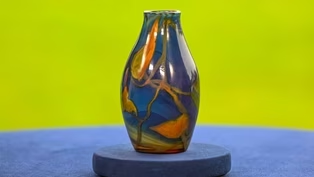
(both laugh) It's a Tiffany paperweight glass vase.
Okay.
But not only is it a Tiffany paperweight glass vase, but it's actually a reactive paperweight glass vase.
So, it's a little more of a complicated technique involved to make it appear this way.
This was a technique that was developed around 1910, 1911.
Really.
The color can be different, whether it has transmitted light or reflected light on the piece.
Okay.
But if we look at it-- and today, we're looking at it more with, uh, reflected light-- it looks one way.
Right.
If we took that light away, the colors would completely change.
Really?
The paperweights themselves were first developed, and it was, like, a very major innovation at Tiffany glassworks.
They started to make paperweight glass just around 1900.
This would have been made in Corona, Queens.
The technique was the same type that you would use on making an actual paperweight, in that you would have hot cased glass, and then you'd put a transparent layer of glass on top.
And as a result of that, the decoration that's trapped in between it... Right.
...so it has a much more three-dimensional effect.
This is leaves and vines, and you can see traces of some type of flower.
I love the blue, is gorgeous.
(murmurs) And the swirling effect in the background.
There are a few imperfections.
Right, yeah.
There are some blisters, and then on one side, there is a blister, and we call it, like, a, a burst bubble.
Oh, that's from manufacturing, is it?
Yes.
Okay.
Now, that will affect the value.
Mm, mm.
Never, nevertheless, I would put a retail value of $10,000 to $15,000.
Really?
Okay-- wow, very nice.
Yeah, that's... Take it out of the closet?
(laughs) For insurance, maybe $20,000.
Okay.
I found it in a barn in Winthrop, Maine, in 1988.
It was my great-aunt's barn.
I'd never seen anything like it, and I just fell in love with it.
I've been using it every day ever since.
It's kind of like a jigsaw puzzle.
I just think it's a really special piece.
People refer to it as Adirondack furniture, made throughout New England and the Mid-Atlantic, in the mountainous regions.
There became a big market for it when people from urban areas started getting their lodges.
So they would want rustic furniture in their lodges.
And there just came this local craft boom, which was part of a movement in the United States in the late 19th century.
You've probably heard of Arts and Crafts style, but there was also a big revival in home crafts.
And the template for these was making something decorative out of what was available.
And some people refer to it as twig furniture.
This is probably laurel or something like it that's had the bark taken off of it.
And then these other pieces are little half-pieces that they cut in it, like you say, almost in a jigsaw puzzle.
This is some kind of willow or some kind of larger vine that grows.
And you can tell by looking at the nails that it was done after 1880.
This kind of furniture was really popular in the late 1800s up through, really, the 1920s.
I've seen lots of pieces of twig furniture or Adirondack style.
And normally, it's just brown, but this one is so cool, because it's very graphic.
Did you have a picture?
I do.
The picture was taken in Danvers, Massachusetts, in the home of my great-aunt's great-aunts.
And it shows the table in their living room, and on the back, it has the location and the date.
Putnamville, um... Putnamville.
Yeah, which is a section of... 1899.
Mm-hmm, yeah.
Well, that fits, that fits right in with where I think it might have been made.
I think a retail price for a folk art show would probably be around $6,500.
Wow.
(laughs): That's great for a barn find.
Love to see, you got anything else from the barn?
(laughing): Bunch of chicken coops.
My uncle was a diver, and when he retired, it was given to him as a gift.
So I don't really know what year it was when it was actually used.
I can just tell you, it's very heavy.
I bought it at an online auction for $100.
I got it broken, and I took it all apart and fixed it.
And I'm looking at the hallmarks inside.
It was made in England, London, England, in 1799, and then it came to Massachusetts.
So I'd like to know how much the thing's worth, 'cause it's got some hallmarks that say it was traced back to the royal family.
So I'm not sure what that adds to the value, but... GUEST: I brought a Miami Dolphins retired numbers football.
I bought it at a secondhand shop... How much did you... ...here in Maine.
How much did you pay?
Uh, ten bucks.
Now, when you came to the show today, you couldn't have known that you were going to visit a diehard Miami Dolphins fan.
And here I am, standing next to a diehard Patriots fan.
(stammering) Correct.
Great juxtaposition.
Mm-hmm.
Who's shown on here?
The 12 is Bob Griese, the 13 is Dan Marino, and the 39's Larry Csonka.
All three Hall-of-Famers.
They've had a lot of great players.
But to this day, the only three numbers that have been retired have been Griese, Marino, and Csonka.
Of course, Griese and Csonka helped Miami to the first and only undefeated season in NFL history, in 1972.
The Dolphins entered the AFL, the American Football League, in 1966.
Six years later, they won-- won the year following.
Of course, the Dolphins have had many Hall-of-Famers, including a coach.
These three stand out.
Marino, prolific passer.
Bob Griese helped helm two of the better teams in NFL history to win the Super Bowl in '72 and again in '73.
Larry Csonka, of course, revered as one of the best running backs in football history, fullback-running back.
It's a specialty ball.
It was painted to reflect Dolphins colors.
It's a Dolphins souvenir.
We can't know how many of these were made.
All three, Griese, Marino, and Csonka, each appear to have used black Sharpie.
What is your thoughts on, on the value?
Have you given it any thought?
You bought it for ten bucks.
I'm not really sure.
I've never seen anything where all three were on the same piece.
That's what stands out-- you don't see all three.
You see Griese and Csonka, they were teammates.
Marino, not, not so much.
At auction, you're looking at a piece that maybe hasn't been sold, that maybe doesn't have a reference point.
But when we look at how Dolphins material tends to play-- and, again, regions matter, so Miami might do a little better than, let's say, New England-- we think that at auction, this piece would sell for about $2,500 to $3,000.
Okay?
You could insure it for considerably more.
You can insure it for about $5,000.
Whoa.
Okay?
And... Whoa!
(chuckling) Whoa-ho, okay.
(whistles) Wow.
I think I'm just becoming a Dolphins fan.
(both chuckle) My mother-in-law is a big collector of a whole bunch of different things-- PEZ is one of them.
She gifted this to my husband and I a few years ago.
She bought it about 30 years ago.
It's a combination set of circus and Disney.
Um, 24 different dispensers.
PEZ as a candy and a brand is as iconic as it gets.
The candy was first introduced in 1927, marketed as a breath mint for adults.
The first PEZ dispenser we ever see was released to the public in 1949.
And the original PEZ dispenser was nothing like you see here.
This, we fast-forward to 1970 here.
And this is the circus series, circus display.
It's not a full display of all circus, as you do have some Disney characters mixed in.
The box itself is in exceptional shape.
The colors on it are absolutely vibrant.
I would say conservatively, at auction, we would estimate this at $4,000 to $6,000 today.
Wow.
That's pretty amazing.
I have a very generous mother-in-law.
It belonged to my mother, who died about four years ago.
She lived in Tokyo for a long time, and she started a great collection of Asian art.
She would have acquired it sometime in the late 1940s, early 1950s.
Perhaps part of the occupational forces in Japan at that time?
Probably-- my, her... Yes.
My father was in the Marines, and she worked for the State Department.
I'm not terribly surprised to find that this came from Japan.
It's not originally from Japan, as it is, in fact, Chinese.
Ah!
But it's a Chinese Buddhist bronze.
Oh.
And these were treasured not just in China, but by the Japanese, as well.
So, a great inspiration to Japanese metalsmiths and bronzesmiths are these Chinese bronzes.
This figure is a specific bodhisattva in the Buddhist tradition, and this is Guanyin.
Guanyin, one could say, is the Buddhist mother of mercy.
Okay.
And a very, very popular figure in Chinese Buddhism.
Guanyin has a bearing that is very serene, protective.
Guanyin bestows peace and mercy and understanding, and so is very inspirational to those who would have an image of Guanyin in the particular shrine or in the temple that they would visit.
She would have been holding, I believe, a lotus flower.
Ah!
Where would it have... So right, right now, she's, she's holding a lotus stem.
There are traces, you may notice, of a little bit of gold.
Mm-hmm.
You have to imagine this completely gilt from top to bottom.
(gasps) You're kidding.
Unfortunately-- no, not at all.
The way the gilding is applied-- and it's best shown in the back-- it's actually a gilt lacquer.
And lacquer degrades.
Lacquer dries out, it flakes away.
So, we can see here, this is a nice little piece of how bright... You can see, the gold hasn't tarnished.
(murmurs) But the lacquer has largely flaked away.
Mm-hmm.
So, it's a gilt lacquer on top of the bronze.
This is from the Ming Dynasty.
This is the second to the last dynastic period in Chinese history.
Specifically, I'd say this dates from around 1600 to 1650... Okay.
...or so.
Maybe even the late 1500s.
Very distinctive.
Oh.
Very Ming.
One of the reasons I can date this as Ming is the size of the head.
The proportions are such that I think Ming.
Another technique that, I look on the underside, this red color.
Mm-hmm.
This comes all the way back from the casting process.
We're looking at this, and we're seeing evidence of how it came out of the foundry.
This is red clay.
There was a clay core that was put into this cavity to keep the integrity of the bronze... Fascinating.
...as it was fired.
And that red clay never goes away.
That is really cool.
In today's auction market, I think this would have perhaps a conservative auction value of $7,000 to $10,000.
(softly): Wow.
Wow.
(chuckles) My mother would be so excited if she was here.
And I'm also very certain that's not what she paid for it.
(chuckles) Quite a souvenir.
PEÑA: At Coastal Maine Botanical Gardens, there is an organic connection between art and nature.
GRETCHEN OSTHERR: One of my favorites is a, a piece called "The Basin" that is down in the Vayo Meditation Garden by David Holmes.
It's this huge piece of Ellsworth Schist that was opened up and then smoothed out and it has water in it.
Another piece that's really beautiful is by a Wabanaki Wolastoqey artist, Shane Perley-Dutcher.
It's these giant oversized fiddleheads that are made in the traditional Wabanaki basket-weaving tradition, but out of metal.
We have a stainless steel sculpture called "Flock of Birds" by George Sherwood that twirls when the wind is blowing, and it's, catches the light, it's quite beautiful.
Most of the art that we have here is by Maine and regional artists, so they have a connection to the place.
GUEST: As far as I know, this is a model 1777, second model, Brown Bess that came from Dover, New Hampshire, with the pouch.
And as far as I know, it's pretty much untouched.
How'd you get it?
I saw it hanging on the wall of a older couple, friends of mine.
And the pouch was given to me first, and then I purchased the firearm later on.
Nice, so it all came from the same place.
That's correct.
So let's talk about the pouch first.
It's actually called a cartridge box.
The British called their over-the-shoulder box a pouch, and then what was worn around the waist a cartridge box.
Here, we weren't that particular.
You see them named all sorts of things-- cartridge boxes, cartouche boxes.
They have all different names for them.
Let's take a look inside.
So, we can see it has 24 holes.
One of the tins is missing.
But these would be to hold the cartridges in place and protect them.
And by the number of cartridges and the form of the box, it's probably post-Revolutionary War to the beginning of the 19th century.
Let's go to the gun now.
What we've got, as you mentioned, is a, uh, British Pattern 1777, uh, Short Land musket in really wonderful condition.
And it's great because it's regimentally marked, which we all like to see.
Mm-hmm.
Um, on the top of the barrel, we've got 65 Regiment, "65 RGT."
And then on the wrist, we've got the brass wrist plate here, with "F-34," for the rack number, for the company, company F, and the number of the man.
So we can definitely tell it's a Pattern 1777 based upon the shortened sear spring lock.
A little bit different than the Pattern 1769 of earlier times.
And the cock is a little bit different than the earlier pattern.
One of the great things that it has, too, is an original whisk-- it's missing the pick, and the whisk would've been used to clean out the pan between shots.
These guns were built, um, by various makers.
There, there were people who would make the barrels, um, the brass parts, the locks, and then they would put it all together.
It's original brown, hasn't been cleaned.
The bayonet is cool in its own right.
Probably not issued with the gun itself, but it's marked "L.I."
and the rack number.
The L.I.
would be for the light infantry company of whatever regiment it was from.
And when they're marked with L.I.
for light infantry, they're a little more collectible than the regular bayonets, with a rack number or without.
What'd you pay for it?
$400.
$400 for the whole group?
That's correct.
Right now, Revolutionary War stuff is fairly hot, uh, but we would put an auction estimate on all of it in the $10,000 to $15,000 range.
Mm-hmm!
Definitely, uh, way more than what you paid for it.
Well, thank you very much.
Well, thank you for bringing it in.
Back in, uh, 1943, my dad was in the 95th Infantry Division.
They did some, uh, desert training, and he had a Saturday off.
They went to the Universal Studios, and, uh, sat down, and all these different movie stars went through, saw that they were military personnel, and offered to sign, sign the menu.
I personally, I just love old menus.
That's something I used to collect, because I think they're kind of fun.
When you start looking at the prices on stuff, it makes you want to cry, obviously.
(chuckles) Yeah.
But the other cool thing about this, because it is wartime, we have the flags up here.
And one of my favorite things is the daily specials.
On Monday, it's "Let's Buy Bonds."
And on Tuesday, "Are You Buying War Bonds?"
(laughs) And on Wednesday... You can imagine, this continues.
Yeah.
Which, there's obviously quite an effort... Yep.
...to, um, buy war bonds to support the troops.
Now, during the war, Hollywood, that was one of the ways they supported.
They had the Hollywood Canteen.
Mm-hmm.
They would invite soldiers.
And what's interesting to me about this is, for a long time, Universal commissary allowed people from the public to come in and eat.
Right.
And it was called "Dine With the Stars."
Right, right.
So they advertised, you could come in, but they actually stopped that.
They probably opened it up just for service members.
Probably, yeah.
And this is from November 13, 1943.
Right.
And it's signed by a whole host of famous people.
It is.
I think the highlight on the front is probably Donald O'Connor, but the back of it is actually my favorite, uh, because we have a huge, beautiful Olivia de Havilland signature.
We have a really nice Bette Davis, Janet Gaynor.
So you have some of these leading ladies, which, I'm sure for him at the time, about to ship out, would've been... Right.
...quite a highlight.
The fold marks don't matter.
I think everybody folded these up and put 'em in their pocket, and you have it nicely framed.
At auction, it's about a $600 to $800 menu.
Okay, great.
Thank you very much.
This is my mother's Jukette, uh, record player that she had as a child.
It lights up and it has, you know, the folding cover on it.
And it's made to look like a jukebox.
In 1988, my partner and I bought an elementary school built in 1909.
These were in the auditorium on pedestals.
This is probably 300 pounds and he's probably 150 pounds.
That's why I'm here.
(chuckles) I used to put 'em in my car on Presidents' Weekend, drive 'em around in a convertible.
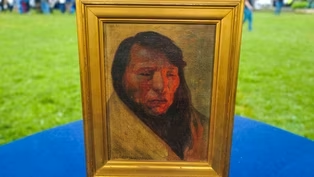
(laughs) GUEST: I brought a painting that was my grandfather's, and it hangs in my bedroom.
My grandfather always put, uh, some information about whatever he had.
So on the back here, it says "Mr.
Couse, "who painted this picture, told me that it was "the portrait of a 'Klinket' Indian "of the Columbia River region by the name of Solaly."
And "It was painted around 1900."
The painting is an oil on canvas by Eanger Irving Couse.
He was a painter born in Michigan.
Um, he was born in 1866 and died in 1936.
He was classically trained.
He studied in Chicago, New York, and in France.
And about 1897 to about 1901, he moved to Oregon to be with his wife's family for a little bit.
And that's where he painted the Northwest coast tribes, specifically the Klickitat, which is when this would have been painted.
So your grandfather was right, circa 1900.
Couse is really famous for his scenes in Taos, New Mexico.
He was one of the founding artists and first president of the Taos Artists' Society.
Do you have any idea what this could be worth?
I, I... I don't.
No idea.
Do you want to take a guess?
$5,000?
If this were to come to auction, I would expect it to bring in the $10,000 to $15,000 range.
(laughing) (chuckling): That's un, that's unbelievable.
Thank you.
I would insure it in the $20,000 to $25,000 range.
Thank you.
I brought in mid-century modern furniture that I inherited from my uncle.
My aunt said that he got them in the 1950s, '60s, something like that.
This desk is known as model 1560.
It was designed by Paul McCobb.
This is from his Planner Group that he designed for the Massachusetts-based company of Winchendon.
Uh-huh.
And the Planner Group in the 1950s was said to be the best-selling mid-century modern design of the period.
This is a DCM chair produced by Charles and Ray Eames.
They were a husband-and-wife team.
Whenever we look at these early Eames chairs, we're always trying to discern, is this from the earliest period of manufacture?
1945, 1946 is when they first produced this for the Evans Product Company.
Uh-huh.
And then, in 1947, production was taken over by the Herman Miller Company.
On the early production that were done for the Evans Product Company, where the chromed metal element meets the rubber shock mount, those are circular.
Here, they're in an oval shape.
The rubber shock mount also has four holes.
That also lets us know... Uh-huh.
...that it's not the earliest period, but it's perhaps one or two generations... Mm-hmm.
...thereafter.
Also, these have what are called boot glides.
So that helps us date it between 1954 and 1960.
Oh, okay.
Has anyone ever adjusted this back?
Ever?
The back has been reattached.
It's actually upside down.
Is it upside down?
It's upside down.
Oh, my goodness!
It's a pretty easy fix.
So there's no harm there.
If these were to come up to auction, we would expect the desk to sell between $600 and $800.
Okay.
And we would expect the chair to sell at auction between $700 and $900.
Okay.
That's great.
They're beads that my aunt gave me 20, 30 years ago.
She grew up in the Miami area.
I'm guessing she got them from her parents.
And I know nothing about them.
It's really just a complete mystery.
About 50, 60 years ago, I bought a house in Brooklin, Maine.
It was an antique Victorian.
The house was selected to be used in the film "Pet Sematary."
They wanted to actually dismantle the sidewalls of the house.
I wouldn't let them do that.
So they basically recreated the whole front half of the house at the armory in Bangor to use as the movie set.
Because I had a copy of the book, I got Stephen King and probably most of the cast to sign it for me.
I don't own the house anymore.
It was great fun, great to be part of it.
This painting belonged to my grandparents and I inherited it.
My grandmother's brother was very good friends with Sheldon Parsons.
And so my grandparents went to visit Santa Fe and met Sheldon Parsons.
And my grandmother was taken with his artwork.
She did not buy this painting there.
She purchased it from him through correspondence.
Okay.
And he mailed it to her in Pennsylvania.
Do you know how much she paid for it?
I have no idea.
She actually bought three through the years.
My sister also has one that's smaller.
Uh-huh.
And my cousin also has one.
You mentioned, uh, there was correspondence, and, and you have that correspondence, right?
I do, yeah.
And that really is the form of, uh, several letters and what we have in front of us, which is in the artist's own handwriting.
This describes the painting, what inspired it.
He describes where it is, and it's 25 miles northwest of Santa Fe, and that it was painted on October of 1940.
Mm-hmm.
Sheldon Parsons was born in 1866 and he died in 1943.
Parsons actually was a known portrait painter in New York.
Oh!
And some of his portraits were of famous people like Susan B. Anthony and President McKinley, for example.
I had no idea.
Sadly, his wife passed away in 1912.
In 1913, having been diagnosed with tuberculosis, he moved to Santa Fe.
That is wild-- wow.
And once he gets there, he starts painting these types of scenes.
He studied it at the National Academy of Design.
So he's got a great background.
He was a member of the Santa Fe art colony.
And he became the first director of the New Mexico Museum of Art.
This particular painting is an oil on board, and it's not signed or dated.
Uh-huh.
Which emphasizes the importance of h, you having kept those correspondences.
For retail purposes, it's probably a $10,000 painting.
(clicks tongue) Wow.
That's terrific news!
(chuckles) (both laughing) I brought a rug that has been in my family for many years.
Family lore has it that it was the second-place winner in the World's Fair, 1939, 1940.
We don't have a ribbon for that second place, but we do have a blue ribbon from Macy's, where she won first prize to get into the World's Fair.
And was this a relative who made this?
Yes, it was my great-aunt Jessie Teed, who I guess was known for her work.
And do you know much about the technique that Jessie Teed was using in making the rug?
I only know from an article that she wrote about her work.
She talked about how she used quarter-inch strips of wool.
That was the best, she said, makes a lightweight rug and very sturdy.
She talked about the burlap that she would use from the flour sacks.
The technique is called hooked rug.
Mm-hmm.
It's where they take the thin wool fabric strips, and with a hook, punch them through the surface and pull them back through to form the carpet's pile.
Okay.
Usually when one thinks about American hooked rugs, you think about folk art.
And this is about as far from folk art as you can get.
Jessie Teed was from Unadilla, New York, which is near Binghamton.
It's sort of rural, South Central New York.
Yes.
And it's a pretty sophisticated design for kind of rural New York at the time.
She's taking these zodiac figures.
It's very, very much an Art Deco design layout.
Oh.
And then in the center, you can see this incredible sailing ship in turbulent, topsy-turvy seas.
And I don't know if you've noticed it, but she signed it "JMT," hidden amongst the waves, which I think is just such a great little touch.
It is, and I did not know that until your crew hung the rug up and I saw it.
She also dated it, which is very difficult to see in here, because it blends in with the waves.
But it's 1932, and I was able to find reference to a 1946 diary written by Nellie Carr, where she's talking about, that Nellie Carr's talking about her grandmother going to live with Jessie and her family.
'Cause Jessie was busy making her rugs and her rug designs, and needed help with the house.
Oh, I did not know that.
Yeah, yeah.
Which really indicates to me that she was approaching this as a profession, and really couldn't be a homemaker anymore because she was busy designing and hooking these rugs.
Right.
Have you ever had it appraised?
I had it appraised a few years ago.
The gentleman said it was worth about $2,000 for insurance value.
In a retail setting today, this rug would be $8,000.
(exclaims softly) Really?
Yeah.
Oh, wow.
For insurance, I would keep it around that same $8,000 mark.
Okay.
Mm-hmm.
I will.
It's just a beautiful... Okay.
...striking, uh, eye-catching design that would have great appeal to a lot of different people.
Wow.
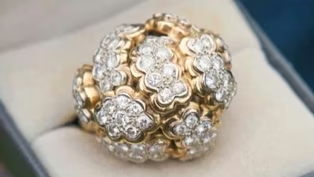
GUEST: It's my grandmother's ring.
She called it the cauliflower ring.
She bought it in the '80s.
And this ring she would "visit" every month to pay off.
Oh, wow.
She would do monthly layaway installments.
And she never really got to get the ring until five years before she died.
(laughs) One of the fewer, last, um, payments that she, she made, she went in and they said, "You know what?
Just take the ring.
We, we don't want it anymore."
Wow.
(chuckles) So she, she, she... She j, she just, they gave her the ring.
They gave her the ring.
I looked at the diamonds-- they're gorgeous.
This ring must have been expensive when she bought it.
I think so.
Do you know what she paid?
We think it was $10,000, but I think her total payments were maybe $8,000?
You know what?
I'm not sure.
She paid the right price.
Because today, you know what it's worth?
I don't know, I'm j, I have a feeling you're gonna tell me.
$8,000.
(laughing): $8,000!
That's what it's worth.
That's great!
I'm excited to hear that.
(speaks softly) I brought a painting by Inez Walker.
I was at an estate sale.
She had a collection of art that was very eclectic.
This is really what I went for, but I, I bought about nine pieces.
The estate sale company, this particular one, you know, the more you buy, the better the deal is, so... Sure.
I think I paid about $400 for all nine pieces.
Well, you know it's by Inez Walker.
Yes.
And it's signed over on the left-hand column.
Did you see that?
I, I didn't.
It looks like it's part of the design.
She is considered an outsider artist.
She created her art outside the mainstream.
I like the term "self-taught."
Inez Walker was born in 1911 in Sumter, South Carolina.
Very tough life.
Very tough life.
She's an orphan at a very early age and she's married by the age of 12 or 13.
Wow.
And comes north, into Philadelphia, with the Great Migration.
And she eventually made her way up into Upstate New York, Port Byron, and worked in an apple processing plant.
Sadly, she kills a man who was abusing her.
Sent to prison.
In prison, she starts to draw.
She started out drawing the other inmates.
She called them "the bad girls."
She got out of prison in 1973.
Your piece was made in 1976.
It's a drawing, colored pencil and ink on a piece of paper.
From across the room, you can tell an Inez Walker.
The features of her pieces are very, very distinctive.
The faces are big, they're bold.
The eyes are typically exaggerated, and the clothing is typically clothing that she wore herself.
She has a fairly large body of work and she trades regularly.
She died in 1990.
Like so many of these self-taught artists, it really wasn't till after her death that the market started to take notice of her work.
Retail, I would put a value on this of $3,000... Oh, my God.
...to $3,500.
No kidding!
No.
(whispers): Wow.
Tough life.
Yeah.
Tough life.
I, I appreciate it even more now.
Yeah, no, it, it is.
(sighs): And these self-taught artists, you know, just... (clicks tongue) (laughs, sniffles) You got me.
(laughing) It gets me, too, trust me.
Just tough.
It's a heartbreaking story.
It is.
It is heartbreaking.
Yeah, I had no idea.
ANDY BRAND: One native plant that does really well here in Maine is Comptonia peregrina, or sweet fern.
It's not a fern per se.
It's actually a shrub.
And it's got this really lovely fern-like foliage that has a spicy fragrance to it, and it has the ability to fix its own nitrogen.
So it's a great plant for soils that are pretty crummy and have low nutrition, and it does admirably well in those situations.
Two of my favorite native perennials in this garden are Christmas fern, as well as our native ginger.
And they're both used here to maintain the stability of the slope.
They spread with rhizomes and keep the soil in place, rather than washing to the bottom of the hill.
GUEST: My husband and I are big readers, and we both come from families that love books.
And we have inherited over the years hundreds of books, maybe thousands.
And it actually got to the point where we had no room for books, so we had to build a special building, which we call our library.
Maybe three weeks ago, I came to him and I said, "My book group has decided we want to read "'A Portrait of the Artist as a Young Man.'
And do we have a copy of, of it anywhere?"
Right.
By James Joyce.
By James Joyce.
And I was sitting in the kitchen.
He comes out of our bedroom and says, "Yeah, we do.
We have this 'Portrait of the Artist.'"
And he opens it to give it to me and he goes, "Huh, look at that.
(laughing): It's signed."
Yeah, so let's open it.
(chuckling): A, and that was, like, a huge surprise.
Oop!
It says someplace in Italy, and it's dated 1928.
19, uh, 20.
1920.
Yeah, so... Right you are.
It's Trieste in Italy.
Oh, okay-- I couldn't read it.
Yeah.
He s, he spent a lot of time in Trieste.
He went in 1905 for the first time.
Oh, okay.
He worked on this book there a lot, too.
Oh, he did?
And he kind of bounced back and forth, because of the First World War.
He was kind of a self-exile at first, leaving Ireland.
He got a job teaching English in Trieste.
But he loved it.
This is the 13th of February.
And this particular stint in Trieste, he was there from the fall of the previous year.
And then in the spring, summer of 1920, he went to Paris and never lived in Trieste again.
Oh, wow.
But that's really helpful, because when we're talking about a signed book, we want to know if the signature looks right, which this does.
Oh, good.
And then the date needs to make sense, because usually, when people are gonna fake things, they're kind of sloppy.
They're not gonna know exactly which month and day he was in what city.
Yeah.
Is this the copy you're reading for your book group?
(laughing): No, I... (laughs) Uh, when I saw that, I went to the library and got a library copy.
(chuckling) And do you have any idea where it came from?
My suspicion is that it's my husband's great-aunt who lived in Boston, on Beacon Hill, and was a friend of many artists and writers-- Eugene O'Neill, people like that.
And she had many-- many of our books came through her.
It's one of the earliest editions.
Oh, really?
And people are pretty serious about James Joyce.
And he didn't, he didn't sign a lot of things.
And this is very important... Oh, really?
...'cause of the age, the 1920 signature, 'cause he's still kind of struggling at that point, which is cool.
He wasn't well-known then.
No.
And being so unusual in his style, a lot of people with Victorian sensibilities were kind of horrified at some of his approaches.
Yes, I can see.
Have you, have you ever thought about what the value is?
I would imagine it's $5,000 or $10,000.
It's just sort of off the top of my head.
This is of, one of the favorite titles of his.
It's nice and early, it has Trieste.
For auction, I would estimate this at $15,000 to $20,000.
Wow, yeah, whoa-- okay.
(laughs) That's pretty nice.
(laughing) I guess I'm not gonna read it.
I have a terrible habit of dog-earing, you know, the pages.
(laughs) So I'm glad I didn't read that one for my book group.
(laughing) Yeah.
(laughing) I can't wait to tell my book group about this.
We're meeting tomorrow, and I haven't told them.
(chuckles) That's a great s... I want to give them a shout-out.
Thanks for picking this title.
(both laughing) It belonged to my father.
He learned to play violin in his retirement and he started collecting violins.
And when he died, he left them all to us.
And we have no idea what they are or what they're worth.
My family had three generations of railroad workers that worked on the Bangor and Aroostook Railroad.
This was one of the lanterns.
Back in the day, they used to, you know, wave it.
(laughing): You know, as they do.
But then, as the years went on, they would attach it at the bottom so that they could just turn it, depending on what the signal was for the train.
GUEST: It's a family piece.
The person who generated it was a, uh, either fourth or fifth great-aunt.
Do you know how old she was when she did the map?
Do you have any idea?
I think she was in her early teens-- 13, 14.
It's a manuscript map.
Everything has been done by hand, and it's called "The United States" by Eliza Ann Oliver.
She drew the map in March either 24 or 29-- we can't read her calligraphy there-- 1823.
So it's very early, and it, it shows the United States and territories at the time.
It's what's called a schoolgirl map.
It represents a shift in 19th-century education for women.
They were educated outside of the home.
Female academies were established.
One of the methods that they used for teaching was maps, and it was a mnemonic device to teach calligraphy, geography, and penmanship.
Her craft of handwriting, you can see her, she's so talented.
She's using at least three different fonts, and she has taken a lot of care with river systems.
And also something I've never seen before is, she has rendered topography with little curls.
So she's rendered mountains in three dimensions.
This map is particularly accomplished and would have taken a long time to create.
This is one of the largest examples I've seen of the so-called schoolgirl map craze.
The craze took place from, I would say, the 1810s to about the 1840s, because by that time, commercially printed maps were available.
So it's just a small window in time when these maps were made.
One other thing I wanted to point out that, is that Eliza won an award.
She got a city award from Boston.
In a retail setting, I would put a value on it between $5,000 and $7,000.
Very nice.
It's a masterpiece.
Thank you.
GUEST: I brought in a big plastic bucket filled with first-run issues of the "Teenage Mutant Ninja Turtles."
Mm-hmm.
From '84... Mm-hmm.
...to some stuff in the early '90s.
We could only choose a few items.
What was your dad's connection to Kevin Eastman, the artist for "Teenage Mutant Ninja Turtles"?
Kevin Eastman worked at what was at the time Johnny's Oarweed from '82 to '84.
Mm-hmm.
And my dad came in and took over the business in '83.
Kevin knew all the ins and outs of the business and really helped my dad to open up that year.
They became friends, and for the printing of the second issue, uh, my dad gave him the loan... Mm-hmm.
...to help start that out.
So what was Kevin Eastman doing at the restaurant?
Uh, he was a waiter, using all of his charm to take care of everybody.
Some of his artistic skill came out on the placemats.
He would sometimes write me little notes that said, like, "Cowabunga."
"Teenage Mutant Ninja Turtles" was a huge phenomenon, especially in the comic book world.
Kevin Eastman and Peter Laird started a small comic company called Mirage in 1983-1984.
"Teenage Mutant Ninja Turtles" was such a huge blockbuster right out the gate.
It was released in 1984 with the first comic book, and then it very quickly got licensed into role-playing games, and trading cards, a TV series, and later, in 1990, became a movie franchise.
And what you've got here is probably a very early representation of Leonardo written on yellow paper from Kevin Eastman.
You've got a first edition, first printing.
And what I find, actually, the most interesting piece is the T-shirt.
Each year, they would make a shirt for the staff of the restaurant.
And this year, Kevin Eastman did the art, front and back, of the Oarweed restaurant.
They put together their first couple issues with no budget whatsoever.
They're really kind of starving artists at this point.
So that loan from your dad probably helped them launch in a huge way.
This is one of the earliest depictions I've ever seen, but is fairly mature in its style.
We've seen some earlier drawings by Kevin Eastman that are a little cruder.
The T-shirt is signed on the back by Kevin Eastman in the art, dated 1984.
I've never seen another one, so that's pretty exciting.
And the comic is gorgeous.
It's in fairly good condition.
This is the issue number one of "Teenage Mutant Ninja Turtles" and it's also a first printing.
Do you have any idea what the value might be?
$8,000 maybe?
You nailed it.
Around $8,000 to $10,000 in this condition.
I love the shirt.
Yes, it's early art by Kevin Eastman, but doesn't have a turtle to be seen on it.
If this was to go to auction, I'd put a conservative estimate of around $800, mm, maybe $1,000.
This, on the other hand, is great.
It's a really early depiction, and the earlier the better.
If this was to go to auction, we'd put an estimate of $40,000 to $60,000 on it.
Whoa.
Radical, man.
(both chuckling) I mean, it can't make up for the memories.
(chuckles) But, uh, that's, that's crazy.
PE PEÑA: And now it's time for the "Roadshow" Feedback Booth.
We flew up all the way from North Carolina to have my great-grandfather's lapel pin appraised, and it appraised for $1,400.
And I got, uh, a watch face from my great-grandpa appraised.
It's a Hopalong Cassidy watch, uh, which is $75 to $125.
(chuckling) Yes, and even though it was rainy, y'all, it was so fun.
Thanks for having us, "Antiques Roadshow."
Yes.
Brought our friend's 1930s Mills slot machine.
The story is, it was taken from one of Capone's speakeasies before they broke 'em up.
Turns out the appraiser said it's just heavy and worthless.
(both chuckling) This is a painting that I acquired from my neighbor Shirley.
Um, I thought it'd be a Czech masterpiece.
Turns out it probably won't cover my hotel tonight, but I love you, Shirley.
I'm here fulfilling a lifelong dream to be at the "Antiques Roadshow" with my mom today.
And I brought along my Bear Lithia water, uh, carboy, which the appraiser said was one of the best carboys he's ever seen.
Yes.
I brought my baby owl.
I spent $20 on it at an antique sale, and it's worth $1,500 to $2,000.
We found out that what we brought is worth more to us than to anyone else.
This painting from Eleuthera, the appraiser said that his parents would be prouder of it than we are.
And the sugar bowl from 1890s is worth four dollars.
But it was worth a million to be here.
Thank you, "Antiques Roadshow."
Thanks, y'all.
PEÑA: Thanks for watching.
See you next time on "Antiques Roadshow."
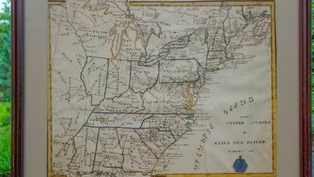
Appraisal: 1823 Schoolgirl United States Map
Video has Closed Captions
Clip: S30 Ep8 | 2m 20s | Appraisal: 1823 Schoolgirl United States Map (2m 20s)
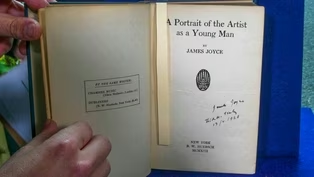
Appraisal: 1920 James Joyce-signed Book
Video has Closed Captions
Clip: S30 Ep8 | 3m 20s | Appraisal: 1920 James Joyce-signed Book (3m 20s)
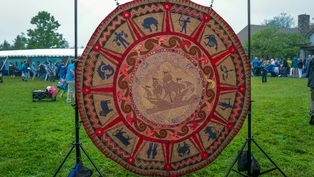
Appraisal: 1932 Jessie Teed Hooked Zodiac Rug
Video has Closed Captions
Clip: S30 Ep8 | 2m 55s | Appraisal: 1932 Jessie Teed Hooked Zodiac Rug (2m 55s)
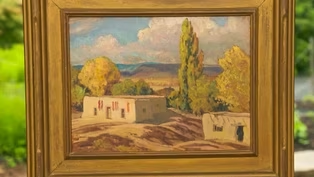
Appraisal: 1940 Sheldon Parsons Oil Landscape
Video has Closed Captions
Clip: S30 Ep8 | 2m 11s | Appraisal: 1940 Sheldon Parsons Oil Landscape (2m 11s)
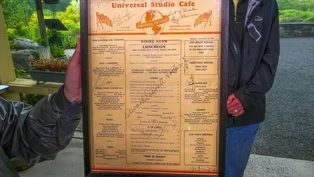
Appraisal: 1943 Signed Universal Studio Cafe Menu
Video has Closed Captions
Clip: S30 Ep8 | 1m 46s | Appraisal: 1943 Signed Universal Studio Cafe Menu (1m 46s)
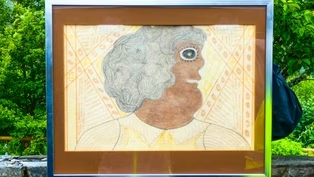
Appraisal: 1976 Inez Nathaniel-Walker Drawing
Video has Closed Captions
Clip: S30 Ep8 | 2m 46s | Appraisal: 1976 Inez Nathaniel-Walker Drawing (2m 46s)
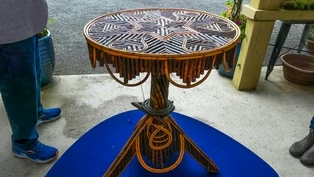
Appraisal: Adirondack Folk Art Table, ca. 1890
Video has Closed Captions
Clip: S30 Ep8 | 2m 30s | Appraisal: Adirondack Folk Art Table, ca. 1890 (2m 30s)
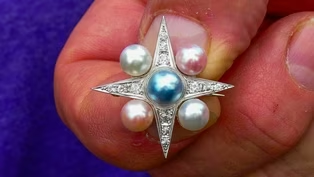
Appraisal: Diamond & Natural Pearl Pin, ca. 1920
Video has Closed Captions
Clip: S30 Ep8 | 2m 46s | Appraisal: Diamond & Natural Pearl Pin, ca. 1920 (2m 46s)
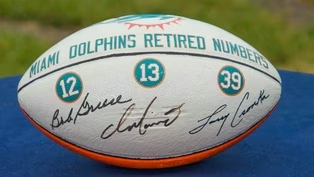
Appraisal: Dolphins Griese, Marino & Csonka Signed Football
Video has Closed Captions
Clip: S30 Ep8 | 2m 24s | Appraisal: Dolphins Griese, Marino & Csonka Signed Football (2m 24s)
Appraisal: Dome Diamond Cluster Ring, ca. 1980
Video has Closed Captions
Clip: S30 Ep8 | 1m 6s | Appraisal: Dome Diamond Cluster Ring, ca. 1980 (1m 6s)
Appraisal: Eanger Irving Couse Oil Portrait, ca. 1900
Video has Closed Captions
Clip: S30 Ep8 | 1m 44s | Appraisal: Eanger Irving Couse Oil Portrait, ca. 1900 (1m 44s)
Appraisal: Marguerite Wildenhain Pond Farm Vessel, ca. 1955
Video has Closed Captions
Clip: S30 Ep8 | 1m 4s | Appraisal: Marguerite Wildenhain Pond Farm Vessel, ca. 1955 (1m 4s)
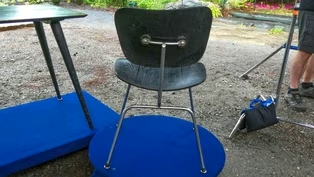
Appraisal: McCobb Desk & Eames Chair, ca. 1955
Video has Closed Captions
Clip: S30 Ep8 | 2m 6s | Appraisal: McCobb Desk & Eames Chair, ca. 1955 (2m 6s)

Appraisal: Ming Dynasty Bronze Guanyin, ca. 1620
Video has Closed Captions
Clip: S30 Ep8 | 3m 13s | Appraisal: Ming Dynasty Bronze Guanyin, ca. 1620 (3m 13s)
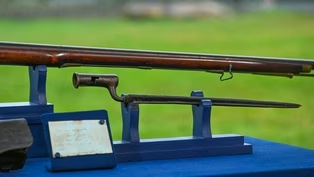
Appraisal: Pattern 1777 Short Land Musket Group, ca. 1785
Video has Closed Captions
Clip: S30 Ep8 | 2m 44s | Appraisal: Pattern 1777 Short Land Musket Group, ca. 1785 (2m 44s)
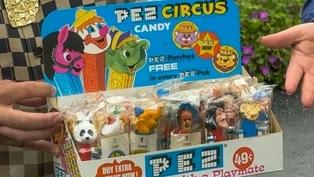
Appraisal: PEZ Dispenser Collection with Store Display, ca. 1975
Video has Closed Captions
Clip: S30 Ep8 | 1m 7s | Appraisal: PEZ Dispenser Collection with Store Display, ca. 1975 (1m 7s)
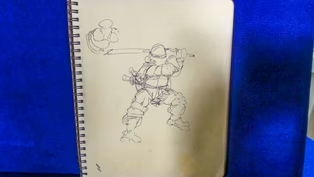
Appraisal: "Teenage Mutant Ninja Turtles" Archive, ca. 1984
Video has Closed Captions
Clip: S30 Ep8 | 3m 3s | Appraisal: "Teenage Mutant Ninja Turtles" Archive, ca. 1984 (3m 3s)
Appraisal: Tiffany Reactive Paperweight Glass Vase, ca. 1911
Video has Closed Captions
Clip: S30 Ep8 | 2m 34s | Appraisal: Tiffany Reactive Paperweight Glass Vase, ca. 1911 (2m 34s)
Appraisal: Uncle Sam Cast-iron Doorstop, ca. 1915
Video has Closed Captions
Clip: S30 Ep8 | 2m 58s | Appraisal: Uncle Sam Cast-iron Doorstop, ca. 1915 (2m 58s)
Preview: Coastal Maine Botanical Gardens, Hour 2
Video has Closed Captions
Preview: S30 Ep8 | 30s | Preview: Coastal Maine Botanical Gardens, Hour 2 (30s)
Providing Support for PBS.org
Learn Moreabout PBS online sponsorship
- Home and How To

Hit the road in a classic car for a tour through Great Britain with two antiques experts.













Support for PBS provided by:
Funding for ANTIQUES ROADSHOW is provided by Ancestry and American Cruise Lines. Additional funding is provided by public television viewers.