Virginia Home Grown
Companion Vegetable Planting
Clip: Season 26 Episode 5 | 6m 41sVideo has Closed Captions
Discover vegetable pairings to grow in your garden for a healthy and bountiful harvest
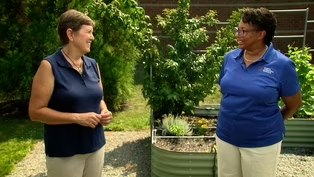
Peggy Singlemann and Shana Williams discuss which vegetables grow well together in the garden and which combinations should be avoided. Featured on VHG episode 2605, July 2026.
Problems playing video? | Closed Captioning Feedback
Problems playing video? | Closed Captioning Feedback
Virginia Home Grown is a local public television program presented by VPM
Virginia Home Grown
Companion Vegetable Planting
Clip: Season 26 Episode 5 | 6m 41sVideo has Closed Captions
Peggy Singlemann and Shana Williams discuss which vegetables grow well together in the garden and which combinations should be avoided. Featured on VHG episode 2605, July 2026.
Problems playing video? | Closed Captioning Feedback
Where to Watch Virginia Home Grown
Virginia Home Grown is available to stream on pbs.org and the PBS app.
Providing Support for PBS.org
Learn Moreabout PBS online sponsorshipAnd, Shana, we've been talking about veggies, and so I brought a few.
>>Awesome.
>>But what I wanted to talk about was the companion planting aspect of planting a vegetable garden.
You know, we just don't willy-nilly throw vegetables out into the bed.
I'm sure you don't either.
>>Sometimes.
>>Sometimes, okay.
(chuckles) But I think with companion planting, the most commonly known one, the most popular one are the three sisters, with the corn, the beans, and the squash, with the corn supplying the height for the pole beans, the pole beans, of course, their roots actually, or they're able to capture nitrogen from the air and then release it into the soil as well as hold it in their roots.
Because corn is really a heavy feeder of nitrogen to be successful.
And then the squash comes along, or cucumbers, and covers the ground, which, of course, retains soil moisture, but also keeps critters out because of the spininess of their leaves.
So it's a great companion planting combination.
>>It really is.
>>It is.
But other companion planting combinations also work just as fine.
And I'll say the most in-depth combination deals with tomatoes and peppers as well as marigolds and/or, and/or, basil.
And let's talk about the basil first because that's really the most, I'll say, elaborate one to talk about.
'Cause when we plant tomatoes, our plants get very large.
It's a vine, and basil, of course, is more stout in its growth.
And so this is a good combination for height variations, where you can grow something tall and something short underneath.
And it also slows down the flowering process so the leaves can stay flavorful longer, all right?
The other thing is tomato roots go deep while basil roots stay shallow.
So even in the soil profile, you've got deep roots and shallow roots, so they're not competing for moisture.
And then finally, we've also got the fact that it's been proven that basil actually enhances the growth of tomatoes but enhances the flavor of them as well.
All right, now on a pesticide side, we've learned and have known for a long time that these plants actually, with their aroma, their fragrance, they actually confuse insects like whitefly and aphids.
And so the insects tend to shy away from the tomatoes, all righty?
>>That's how I grow 'em, basil and tomatoes together.
>>And you'd use a lot.
You don't put one at the end of the row and call it a day.
>>No, I have a whole row.
>>See, you're talking my tune.
>>Yeah.
>>Same with marigolds, though, that fragrance there, you know, it's got a pretty sharp fragrance too.
And so you want to put that into the garden 'cause it, too, confuses and actually draws in the aphids and the whiteflies, but it also draws in robber flies as well as ladybugs to take care of any aphids and other insects that might make it through.
So, and again, not just one at the end of the row.
>>Yeah, and I think you mentioned it's better to have the smaller ones rather than the large ones.
>>Absolutely.
The smaller, the better.
This is a signet marigold, and this is a French marigold.
And, again, with their roots, they actually put out biochemicals which reduce root-knot nematodes, which is a parasite in the soil that would ruin our crop.
Now, you want to attract pollinators, so we have zinnias as well to bring in some more of our pollinators 'cause we wanna be able to pollinate all those flowers so we have more vegetables.
But there's other combinations as well, and I'm sure you're familiar with them too.
>>Yes.
>>Yes.
Now, think about, again, we're talking tomato roots go deep.
So carrots grow very well with peppers and tomatoes.
But, also, carrots grow very well with lettuce because of this long taproot and the very shallow roots of the lettuce.
And the lettuce and the carrots will kind of shade each other out because both of these are cooler season crops.
So when our temperatures get to 90 like they are right now, our soil temperatures, these two plants don't thrive well.
But they do need a little bit of shading.
And then believe it or not, if you can put your cucumbers up on a trellis so they're, you know, growing up and not sprawling on the ground, then lettuce and cucumbers grow well together.
Again, they benefit each other in that one provides shade for you to have lettuce further into the season.
>>And can we sprinkle the seeds for carrots later, knowing that the fall is gonna be coming, and they can start being prepared?
>>Exactly, matter of fact, mid-July is a great time to start sowing your carrots for the fall crop.
And you can intersperse it with those cucumbers as well.
Now, beans, which I mentioned already, are phenomenal plants, okay.
You have bush beans and pole beans, and you've gotta space them so they have good air circulation, particularly with the humidity we've been experiencing lately.
But, again, these are fantastic legumes, like peas, and they pull in the nitrogen from the air, go through a lot of processes within that plant, and put that nitrogen into their roots and nodules or exude it out into the soil some.
So a good combination of cucumbers and beans.
However, there's some bad combinations too.
Are you familiar with a very bad combination?
>>Yes.
(chuckles) >>I'll let you point out the bad combination.
>>So say, for instance, you got your beans and your onions; they don't like each other, but tell me why.
>>Okay, the reason is 'cause the onions actually have exudates, biochemicals that they push into the soil, and they last in the soil, and they hamper the growth of the beans.
They'll become very distorted, very short, and they won't produce.
However, the good news is that onions, which include garlic and alliums, all the alliums, which are your chives and things, grow very well with beets and carrots because those exudates actually protect these from insects like carrot maggot, which drills little holes all through your carrots.
>>Oh, yes.
>>Yes.
So companion planting does have its benefits.
Now, the other thing I'm going to share, just as a closing, is that watch your source.
Please always go to Virginia Cooperative Extension to get your information.
'Cause there's a plethora of information on the internet, and you want solid, factual, research-based info to follow so that you can succeed in your vegetable garden.
>>Yes.
>>Yes.
Have you used this in your garden?
>>I have, and you know, funny thing is I've even planted strawberries with a onion on the end, or I even put a bell pepper with strawberries growing up just to take advantage of the height.
And all of these is various combinations.
And I'll even put my, what is it?
My onions with my bell peppers.
>>Mm-hmm, mm-hmm.
So these are all combinations that you figured out work in your garden, and again, using guides to come through to that.
So good news, good things, easy practices to follow with just a little bit of advanced planting and planning.
>>And put basil next to everything.
>>Everything.
>>It tastes good.
>>Yes, it does taste good.
(laughs) It's a fav of mine too.
(laughs)
Video has Closed Captions
Clip: S26 Ep5 | 7m 50s | Tour a garden at a rural hospital focused on improving food security and community health (7m 50s)

Video has Closed Captions
Clip: S26 Ep5 | 8m 16s | Visit a farm in a public housing community providing fresh food and leadership training (8m 16s)
Video has Closed Captions
Clip: S26 Ep5 | 5m 39s | Relax with a refreshing herb infused beverage after a day in the garden (5m 39s)
Video has Closed Captions
Clip: S26 Ep5 | 4m 14s | Create a container full of tomatoes and herbs to top homemade pizzas (4m 14s)
Video has Closed Captions
Clip: S26 Ep5 | 3m 33s | Learn why high heat slows tomato pollination (3m 33s)
Providing Support for PBS.org
Learn Moreabout PBS online sponsorship

- Home and How To

Hit the road in a classic car for a tour through Great Britain with two antiques experts.

 New Episode









Support for PBS provided by:
Virginia Home Grown is a local public television program presented by VPM