
Heartland Farms, Food & Farm Exploration Center
Season 16 Episode 11 | 26m 48sVideo has Closed Captions
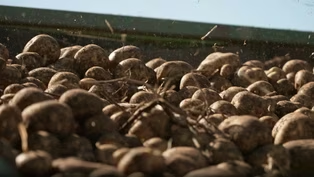
Heartland Farms grows hundreds of millions of pounds of Wisconsin chipping potatoes.
Luke visits Heartland Farms in central Wisconsin, where fifth-generation farmer Jeremie Pavelski oversees hundreds of millions of pounds of chipping potatoes grown each year. Next, a stop at the Food + Farm Exploration Center in Plover reveals how exhibits and a teaching kitchen reconnect visitors of all ages to how food is grown.
Problems playing video? | Closed Captioning Feedback
Problems playing video? | Closed Captioning Feedback
Wisconsin Foodie is a local public television program presented by PBS Wisconsin
Heartland Farms, Food & Farm Exploration Center
Season 16 Episode 11 | 26m 48sVideo has Closed Captions
Luke visits Heartland Farms in central Wisconsin, where fifth-generation farmer Jeremie Pavelski oversees hundreds of millions of pounds of chipping potatoes grown each year. Next, a stop at the Food + Farm Exploration Center in Plover reveals how exhibits and a teaching kitchen reconnect visitors of all ages to how food is grown.
Problems playing video? | Closed Captioning Feedback
Where to Watch Wisconsin Foodie
Wisconsin Foodie is available to stream on pbs.org and the PBS app.
Providing Support for PBS.org
Learn Moreabout PBS online sponsorship- Luke Zahm: This week on Wisconsin Foodie: - Jeremie Pavelski: We grow potatoes.
Most of our potatoes are going for the chip industry, which is, you know, folks who make potato chips.
For total acreage of potatoes, it's roughly 12,000 acres.
To put that in perspective, we'll grow a little over 600 million pounds of potatoes annually.
- Luke: You have a 70-year relationship with Lay's, right?
Like, all those Lay's potato chips that, and the various iterations, you're telling me that those are produced with these potatoes?
- Jeremie: They are.
Those are produced with these potatoes right here.
And a lot of them will end up getting shipped out the same day and converted into potato chips at their Beloit facility.
- Alexandria Behrend: Our mission here at Food and Farm Exploration Center is to educate current and future generations about sustainability and innovation in agriculture.
- Luke: I'm here with my man, David Lynch.
What have we got today that we're cooking up?
- David Lynch: What are we doing today?
We got a pork loin, which we are going to turn into a schnitzel by-- - Luke: You're a schnitzel.
[both laugh] Wisconsin Foodie would like to thank the following underwriters.
[gentle music] - Did you know Organic Valley protects over 400,000 acres of organic farmland?
So, are we an organic food cooperative that protects land, or land conservationists who make delicious food?
Yes; yes, we are.
Organic Valley.
- Other sausage makers use the AI-generated voice of their namesake and founder.
Our products are finely crafted, made from time-honored recipes with ingredients you can actually pronounce.
Jones: Making breakfast better since 1889.
- The Wisconsin potato and vegetable growers are proud underwriters of Wisconsin Foodie.
It takes love of the land and generations of farming know-how to nurture a quality potato crop.
Ask any potato farmer and they'll tell you, there's a lot of satisfaction in healthy-grown crops.
- Employee-owned New Glarus Brewing Company has been brewing and bottling beer for their friends, only in Wisconsin, since 1993.
Just a short drive from Madison, come visit Swissconsin and see where your beer's made.
- With additional support coming from The Conscious Carnivore.
From local animal sourcing to on-site, high quality butchering and packaging, The Conscious Carnivore can ensure organically raised, grass-fed, and healthy meats through its small group of local farmers.
The Conscious Carnivore: Know your farmer, love your butcher.
- Also, with the support of the Friends of PBS Wisconsin.
[upbeat music] - Luke: We are a collection of the finest farmers, food producers, and chefs on the planet.
We are a merging of cultures and ideas, shaped by this land.
[brats sizzle] We are a gathering of the waters, and together, we shape a new identity to carry us into the future.
[glasses clink] We are storytellers.
We are Wisconsin Foodie.
[dreamy music] - Jeremie: My name is Jeremie Pavelski.
I'm president of Heartland Farms.
I get the honor to be the fifth generation of our family at the helm of our wonderful farm.
We grow potatoes.
Most of our potatoes are going for the chip industry, which is, you know, folks who make potato chips.
For total acreage of potatoes, it's roughly 12,000 acres.
To put that in perspective, we'll grow a little over 600 million pounds of potatoes annually.
What differentiates us, I think, a lot is our passion for not only the crop and the agronomy and our passion for people, but our passion for technology.
Our whole team is really, really excited about that.
And, you know, it's this wonderful mixture of technology and you still need that old-school knowledge and grit, you know, about the crop, about the agronomy, about the storage.
The more that we know, and the more that we can quantify about the crop, about what's happening, you know, the quicker we can respond.
And all of these things really are also a sustainability play.
- Luke: Jeremie, what a pleasure to be here with you today.
- Yeah, Luke, pleasure.
Thank you for coming.
Yeah, so, over here, we're in Hancock, Wisconsin.
And to the back of us, we are harvesting this field of potatoes right over here.
And these potatoes are what we call chipping potatoes.
- Luke: What do you see?
What makes this different than, say, a russet potato that you would find in the grocery store?
- The shape is gonna be a little bit different.
You know, for a russet, normally it's gonna be elongated quite a bit.
The thing that you can't see here is that our solids, so our starch is typically higher in the potato, and the sugar content is gonna be a lot lower.
- Luke: Okay.
- Jeremie: And the other thing about a chipping potato, it's one of those things that works great for making a chip.
It can also make it a lot harder to store is the skins are a lot thinner... - Sure.
- ...on a chipping potato as compared to a russet.
And the reason for that is they are specific varieties with thin skins so that you have less waste.
- Luke: I mean, it's so thin actually, it almost as if it's not there.
[laughs] - Jeremie: Yeah, it doesn't take much to just push it right off.
There you go, let's wipe it off right there.
- Luke: Wow, that's incredibly delicate.
- Jeremie: It is, which also means we got to handle 'em very, very gently.
- Luke: Yeah.
- Jeremie: Even across very large equipment.
- Luke: How many pounds of chipping potatoes does this farm produce every year?
- Jeremie: Yeah, we'll produce over 650 million pounds of chipping potatoes every single year.
- Luke: That number is mind-blowing to me.
I mean, geographically speaking, you have to be one of the largest food-producing farms in the state of Wisconsin.
- Jeremie: You know, we're a large farm, and we've grown over the generations.
So, we started out in 1873 when my great-great grandfather emigrated from Poland and settled in Amherst Junction, Wisconsin.
Which is-- That area has grown up quite a bit.
And then we've continued to innovate, continued to grow.
And, you know, part of this, you know, is also that you got to have great partners that you're working with.
And I'm gonna utilize Lay's as an example here.
We've been working with them for over 70 years now.
The two organizations have grown together.
The two families, quite honestly, have grown together.
I consider them part of our family, and they consider ourselves, you know, part of their family.
- You just mentioned the fact that you have a 70-year relationship with Lay's, right?
Like, all those Lay's potato chips that, and the various iterations, you're telling me that those are produced with these potatoes?
- Jeremie: They are.
Those are produced with these potatoes right here.
And a lot of them will end up getting shipped out the same day and converted into potato chips at their Beloit facility.
So, that's really neat.
And then some of 'em we'll store for up to nine, ten months of the year, and they'll be shipped to be turned into potato chips.
- Luke: Well, Jeremie, it is a beautiful day and I'm really looking forward to seeing what goes into the Heartland Farms potato operation and getting to do some work with you.
[groovy music] Okay, so the potatoes have come in.
What happens once they come in on the trucks?
- Right behind us, the potatoes are coming in on the truck.
They're going through our rinse facility, and then they are getting loaded onto a semi to be turned into potato chips.
The rest of the trucks that you see coming in here are getting unloaded into a potato storage bin, where we're filling those up so that we can make sure that we can have delicious chips all year long.
So, those potatoes can get stored for up to, you know, 10, 11 months.
- Luke: So, once the potatoes arrive and they're offloaded, how do they get into the process of, you know, being sorted, washed?
- Yeah, so they're gonna take a nice gentle transfer on a conveyor.
And then, what they're gonna do is they're going to go into what we call an Evenflow.
And that just creates a very consistent flow of potatoes for the rest of the process.
Then they're gonna go through a barrel-- It's called a barrel washer, but it's really just rinsing the potatoes.
And it's almost like a gentle motion or gentle wave going back and forth with the potatoes as they're moving through this.
That gets off most of the soil.
Then, after that, we have what are called brush washer.
And it has these brushes that are spinning around and making sure that it's cleaning the rest of the soil off.
From there, potatoes travel through an optical sorter, and we're looking for any potatoes that are green, if there was any rot on 'em.
We're also looking for things like corn stalks or, believe it or not, golf balls.
People like to hit golf balls into fields.
That's a real thing.
[Luke laughs] So, it's gonna kick out those golf balls.
- Luke: They make terrible chips, by the way.
- It'd be horrible, yeah.
So, you know, we wanna keep the golf balls over here.
- Luke: Yeah.
- Jeremie: From there, we have our gradings team, and what they're doing is they're also-- We got the human inspection of that product.
And then, we also have one more AI-powered optical sorter before the potatoes get loaded into a bin.
And as soon as the truck gets here for where it needs to go, the semi, the potatoes, we have 'em ready for that bin.
We punch a couple buttons, that truck gets loaded.
From there, it heads down to the manufacturing, chip manufacturing facility.
- Luke: This is mind-blowing.
I mean, I'm kind of out of superlatives here because it's-- It's something, like, to take for granted every time you pop that bag of chips, you know, where that's all coming from, and the amount of care and precision that is employed to just make that happen, my gosh, Jay, you are-- You're really doing it right out here.
- Well, I appreciate that.
And, again, it's really our team, you know, their diligence to it.
You know, the-- You know, all the partners that we work with, it does, it takes a community to make it happen.
- Yeah, it does.
- And, well, we're passionate about it.
- I can see that, I can see it.
Finally, we get to a part I can understand: chips!
- Jeremie: These are our quality samples that, whenever we're sending out a truckload of potatoes, we check over here just to make sure that we see the quality, taste the quality.
- Luke: What makes for a great potato chip?
- Jeremie: Yeah, so, what makes for a great potato chip is it's got the right size profile.
- Luke: Okay.
- Jeremie: It's a nice shape, it's a nice color.
Again, getting back to that sugar content.
You don't see any green potatoes because that just wouldn't be visually pleasing.
And the taste.
- Luke: Yeah, okay, okay, yeah.
- I mean, the most important thing is the taste.
It just tastes great.
[Luke laughs] Cheers.
- Luke: Cheers.
That's a world-class chip.
Even still, the flavor profile is very clean, obviously, because they're very thin and very crispy, right?
The profile, though, is really pleasing.
Like, I've always thought that, you know, the amount of salt that you find on chips, there's a lot of added.
But now, I'm realizing there is natural good flavor in there.
You don't actually need a tremendous amount of salt.
They're really satisfying on their own.
I mean, I gotta say, this is super impressive for a couple Polish kids from central Wisconsin, man.
This is amazing.
- Thank you.
- Yeah.
- How many Polish kids does it take to grow a potato?
- I don't know.
How many?
- A lot.
We got a lot of Polacks here.
[Luke laughs] - So, while these are the best chips in the world, and I don't wanna cut you off by any means, we have a date at the Food and Farming Exploration Center.
- Jeremie: Yeah.
- Luke: Up in Plover.
And, you know, I know you have your fingers in that pie too.
Tell me a little bit about Heartland's farm connection.
- Jeremie: So, the Food and Farm Exploration Center really was a vision that has come to a life with a really big passion of my father.
And that was helping the consumer, government agencies, anybody that you can think of understand agriculture, where their food comes from, how it's grown, the technology, the passion, the love for that food, for that produce that went into it and, you know, have people understand that and take it to heart, because food is the common ground that we all share.
Without sustenance, we're not here.
- Luke: Right.
- Jeremie: And a lot of times, people get scared about their food.
Well, the reality is, is once you understand what's going into it from a farmer standpoint and the care, it's not so scary.
- I know I'm never going to pop another bag of Lay's and take for granted where that chip came from.
That is something that I know heals a lot of the burdens of the agricultural community, rural America.
I mean, that level of understanding and appreciation goes a long way in the upper Midwest.
We love that about this place where we live.
I am over-the-moon excited, my brother.
- Yes, thank you... - Thank you so much.
Thank you for everything you're doing.
- ...for coming out here and sharing the story.
- Oh, man, this is my pleasure, truly, truly.
- Alexandria Behrend.
I'm the executive director here at Food and Farm Exploration Center.
Our mission here at Food and Farm Exploration Center is to educate current and future generations about sustainability and innovation in agriculture.
So, we are in beautiful Plover, Wisconsin.
We are an exploration center.
So, we focus on-- We have 61 interactive exhibits.
We just opened our 61st with the greenhouse so we can grow our crops all year long so people can learn.
We have everything so people can understand and get involved in learning about agriculture, whether you're 2 or 92, through our interactive exhibits.
So, we have just about five acres of demonstration fields in the back where we rotate our crops.
We focus on our-- We have focus crops.
We always have several varieties of potatoes that we grow.
This year, we grew six varieties of potatoes.
We also grew cucumbers, corn, green and yellow beans, and all the peas you could imagine.
[laughs] And we use those right in our event space and our café, along with the community U-picks that we just mentioned earlier.
And we also help with food banks, so they are able to come out and harvest for their food banks as well, to give to their constituents.
We're just a gathering place for the community.
We have a café on site, the Colorful Plate Café.
At the Colorful Plate, our mission is to source as local as possible with our food.
We have many Wisconsin partners that we source our meat and our produce that we don't grow here or we cannot source here if it's out of season.
Our maple syrup is sourced locally.
Our drinks in the café are-- Wollersheim is our current wine or our winery of choice.
And so, we have their drinks in our café.
Point Beer, right around the corner from us, they're our local beer provider.
And so, it's just really fun to be a showcase of all the things special that happen in Wisconsin.
Yeah, so it's extremely important that we understand where our food comes from.
Dick Pavelski, our founder, he says people don't protect what they don't understand.
And so, we need to help people understand that their food is grown in the ground.
And it's really important that we maintain a local connection because food is our greatest power.
And so, it's just really a state of the art.
There's nothing like it in the rest of the world where both kids and adults can come to learn about agriculture and be reconnected to where their food comes from and people that grow it.
Oh, Chef Davey at Food and Farm, he is on our education team, and he is really that connector between everybody loves food and they love to try new food, but often, it's really intimidating, especially if you're at home alone and you're like, "Oh, am I doing this right?"
But in our kitchen lab here at Food and Farm, it's been outfitted with all the equipment that you would have at home.
So, we don't have commercial products in there.
The stove looks like your stove at home, and the sink looks like your sink at home, and the counter, it looks like your counter at home.
And he is just-- He's beautiful at connecting with our community.
- I'm here with my man, David Lynch.
We are at the Food and Farm Exploration Center, located in beautiful Plover, Wisconsin.
Davey... - Yes.
- What have we got today that we're cooking up?
- What are we doing today?
We got a pork loin, which we are going to turn into a schnitzel.
- You're a schnitzel.
[both laugh] - I've been called many things before, but a schnitzel is not one of them.
But we are going to encrust that in Lay's potato chips today to make our pork schnitzel.
We're gonna serve it with some agrodolce sauce and put our Wisconsin flair on it by adding some cranberries and some other Wisconsin products to that.
Serve it over a bed of some very simple cheesy grits, and then a simple zucchini ribbon to elevate it, literally.
- Nice, I like that.
I like the literal elevation.
I like the metaphorical elevation.
Talk me through the starting of the process.
- Well, first we gotta tenderize and flatten our pork chop here.
It's a pork loin chop.
I feel like there's a little more moisture in the pork loin chops than a regular pork chop.
So, we gotta beat it, right?
We gotta whack it.
I like a couple tools for this.
We're gonna start with something round, start getting it flat like this.
So, we see all these ridges in here.
So, I'm gonna use a different tool.
One of the best tools, of course, a meat mallet.
But this has got a bigger surface area.
[sauce pan pounds] And we are starting with this process first because we want to allow a lot of time for this simple seasoning of salt and pepper to penetrate the meat and start drawing some of that moisture to the top.
So, I'm gonna season both sides of that pork over there.
All right, we gotta move on to our agrodolce sauce here.
So, the translation, "agro" meaning sour or sharp and "dolce" meaning sweet too.
The sour being some sherry vinegar today and the sweet being some Casimir Gold maple syrup... - Luke: Yeah!
- David: ...which I'm sure you're familiar with too.
But first, we're gonna start sweating some ingredients.
Start by adding just a little olive oil, and then we can prep our ingredients.
Now, I'm going with a Cortland apple.
Do you know why I chose Cortland for this?
- Luke: I have no idea.
- David: 'Cause it's the kind of tree that grows at my in-laws house.
So, then we're gonna go with this onion, which I plucked right from our garden outside there.
- Sweet.
What's next in your agrodolce?
- David: We're gonna just add, continue adding some fresh aromatics with some fresh garlic here.
- Luke: Sure.
- David: All right, so maybe explain how-- This is gonna take a little bit, so we're gonna move on to our grits before we come back to that.
- Okay.
- David: Yep, so these simple five-minute grits, we just got a pot of water that's boiling here, and we're gonna add our grits, and then we're gonna, once those soak up a bunch of water, then we can add some Wisconsin cheddar, again, adding some more Wisconsin flair with some butter and some parsley that was, again, grown right outside in our herb garden.
- Luke: Awesome.
- David: All right, Luke, now that our grits are rolling here, we can move back to our agrodolce sauce too.
And what we're gonna do to add some even more Wisconsin flair to that is to add some Wisconsin cranberries too.
We're going to add our sour part, our agro part to our sauce, which is sherry vinegar.
And then, we can add our aromatics.
And then, we want that vinegar to reduce a bunch, right?
- Luke: Sure.
- David: Here we have some dried orange peel, some cinnamon.
I like warming spices in an agrodolce.
And some black pepper as well, so I can just add those.
Then we're gonna add some freshly-grated nutmeg too here.
So, we got one last step.
I'll let you do the honors.
This is definitely a French technique and a very Wisconsin technique.
We're just gonna get it super glossy and shiny by adding a little pat of butter.
- Get that in, I'll work that around a little bit.
That's beautiful.
All right, I'm gonna set that there.
- All right, that can just sit and chill.
Now, we just gotta finish off our grits real quick, and then we can move back to our pork chop.
We got some Wisconsin cheddar, adding another knob of butter, and some fresh parsley that we picked outside too.
We're just gonna add that in, get it all melty and stirred in.
That's gonna help kind of make it stand up on the plate a little bit better.
- Luke: Nice.
Oh, I like that.
I can start to see that cheese get a little bit tacky.
Right, that's that pull that we want.
- David: Mm-hmm, the cheese pull.
- Luke: Mm.
- David: And with that parsley in there, we got Packer colors too, right?
[Luke laughs] Yeah.
- Luke: So, we've got our agrodolce done.
We've got our grits now that are gonna set up a little bit here.
- David: It's time to bread our pork chop and shallow fry that guy.
- Luke: We've got the pork.
It's been pounded.
It's been seasoned.
- David: Yep.
We are gonna go through the triple dredge process, right.
I'm sure you're familiar with, you know, if you're making a beer-battered cod or anything like that.
But I like to use 50/50 of flour and cornstarch too.
Cornstarch makes it real delicate.
Flour's a little more del-- a little more dense after cooking.
And I want that kind of balance there.
But then, we're gonna need to hit it with the dry, then hit it with our egg wash, and then hit it with our crumb, which is our Lay's potato chips, which we will need to throw through the food processor first or, at home, put it in a big bag and whack it like you did the pork chop or something like that too.
Then we're gonna fry it, and then we can almost start to plate.
[bright music] So, that was about three minutes each side, right?
- Luke: Yeah.
- And just like a steak, we're gonna let it rest.
And plus, we don't wanna chomp right into that too.
We will be burning our face.
- Luke: Yeah.
- David: I'm just gonna let that chill while we finish plating up.
We only got one more step.
That's make our zucchini garnish.
I want you to do just really long ribbon strands.
And try to get a little bit of green on each side of those.
Each side of those strips here.
All right, we can plate.
We're gonna lay a base of these Wisconsin cheddar corn grits here too.
And they're standing up real nicely too, 'cause we want that height.
We want the altitude of this dish too.
That looks like a good portion to me too.
Then next, we can plop our potato chip-encrusted pork schnitzel right on top of that.
We're gonna add our maple cranberry agrodolce sauce.
- Luke: Ooh, I like it.
- Do you wanna help me out?
- Yeah.
We're just gonna make some of these cylinders to add that altitude.
- Luke: Look at that.
- David: We're just gonna stick 'em up like that.
Kind of creating a bunch of little... little zucch cans.
[Luke laughs] Zucch can dos.
- Luke: Zucch can dos?
- And that's the whole dish.
Are you ready to take a fork to it?
- Luke: I'm ready to fork it up, man.
- David: All right.
- Luke: Yeah.
That looks delicious.
I can hear those chips crunching off.
- Yeah, and this is definitely a dish you want a little bit of that grits, a little bit of that sauce, a little bit of that pork, a little bit of that zucchini all in one bite too.
There you go, that's the perfect bite right there.
- First thing that gets me is the crunch.
- David: Mm-hmm, mm-hmm.
- Right, those chips.
- David: So, the potato chip is the star of the show.
- Hey, I'm telling you, man.
And then, you get that richness, obviously, associated with the grits and the pork.
But the thing that keeps me coming back, honestly, is that agrodolce, that sweet and sour, you know, it dances on your palate.
It's one of those flavor profiles that just keeps lingering and lingering and lingering.
And I like the-- the vegetal nature of the zucchini on there too.
I think it's really innovative.
It's fun, it's artistic, it's playful.
But it does actually add a really, really nice flavor component.
- Yeah, and kind of balances things out too.
- Yeah.
- And in a lot of different senses, not just flavor, but fat and things like that.
- Get in here, bud.
I can't do this by myself.
- David: All right.
- Davey, always a pleasure, my man.
- You bet.
- Thank you.
- Should we eat some more chips?
- [laughs] Chips and chips and chips!
High five, ooh, yeah.
- David: Very good.
- Luke: That was a good high five.
That was a very good one.
I wasn't even, like, looking.
[bright music] [gentle music] - Did you know Organic Valley protects over 400,000 acres of organic farmland?
So, are we an organic food cooperative that protects land, or land conservationists who make delicious food?
Yes; yes, we are.
Organic Valley.
- Other sausage makers use the AI-generated voice of their namesake and founder.
Our products are finely crafted, made from time-honored recipes with ingredients you can actually pronounce.
Jones: Making breakfast better since 1889.
- The Wisconsin potato and vegetable growers are proud underwriters of Wisconsin Foodie.
It takes love of the land and generations of farming know-how to nurture a quality potato crop.
Ask any potato farmer and they'll tell you, there's a lot of satisfaction in healthy-grown crops.
- Employee-owned New Glarus Brewing Company has been brewing and bottling beer for their friends, only in Wisconsin, since 1993.
Just a short drive from Madison, come visit Swissconsin and see where your beer's made.
- With additional support coming from The Conscious Carnivore.
From local animal sourcing to on-site, high quality butchering and packaging, The Conscious Carnivore can ensure organically raised, grass-fed, and healthy meats through its small group of local farmers.
The Conscious Carnivore: Know your farmer, love your butcher.
- Also, with the support of the Friends of PBS Wisconsin.
Preview: Heartland Farms, Food & Farm Exploration Center
Preview: S16 Ep11 | 15s | Heartland Farms grows hundreds of millions of pounds of Wisconsin chipping potatoes. (15s)
Providing Support for PBS.org
Learn Moreabout PBS online sponsorship
- Food
Christopher Kimball’s Milk Street Television
Transform home cooking with the editors of Christopher Kimball’s Milk Street Magazine.





Support for PBS provided by:
Wisconsin Foodie is a local public television program presented by PBS Wisconsin