
Immutable
3/6/2026 | 1h 25m 31sVideo has Closed Captions
Students from Washington D.C. push themselves to become top-tier debaters and change their lives.
Follow a group of students from the Washington Urban Debate League as they fight to find their voices in a world that too often tries to silence them. Against the backdrop of a city marked by inequality, these young debaters confront daily challenges that range from housing instability to neurodivergence. For some, debate is a path to college. For others, it’s a lifeline.
Problems playing video? | Closed Captioning Feedback
Problems playing video? | Closed Captioning Feedback
Immutable
3/6/2026 | 1h 25m 31sVideo has Closed Captions
Follow a group of students from the Washington Urban Debate League as they fight to find their voices in a world that too often tries to silence them. Against the backdrop of a city marked by inequality, these young debaters confront daily challenges that range from housing instability to neurodivergence. For some, debate is a path to college. For others, it’s a lifeline.
Problems playing video? | Closed Captioning Feedback
How to Watch Immutable
Immutable is available to stream on pbs.org and the free PBS App, available on iPhone, Apple TV, Android TV, Android smartphones, Amazon Fire TV, Amazon Fire Tablet, Roku, Samsung Smart TV, and Vizio.
Providing Support for PBS.org
Learn Moreabout PBS online sponsorshipMADISON: When I first started debate in fifth grade, I wasn't sure about it at first, I'm like, oh man, these people are talking all fast.
What is this?
(fast unintelligible speaking).
EMMANUEL: Debate trains you to be someone who can see from both sides.
WILL: You might have street smarts, you might have knowledge, but no one listens.
♪ TONE P: I heard this is America.
♪ JUDGE: What is your definition of the American dream?
AYANNA: That is not immutable, you know, I can change it.
♪ TONE P: America.
♪ ♪ Reflection of America.
♪ (theme music playing) (Go-Go music playing).
♪ SINGER: Hey.
♪ (Go-Go music playing).
♪ SINGER: Hey.
♪ (Go-Go music playing).
♪ SINGER: Hey.
♪ ♪ SINGER: Ho, ho, ho, ho, ho.
♪ COACH: And we're off.
Welcome to Debate Camp.
DAVID: Only one boy, Carter.
You know where you're going.
SITARA: Yes.
DAVID: You know where you're going.
(Go-Go music playing).
DAVID: Who can tell me what we're talking about this year?
COACH: The negative wants something to be hard to the affirmant, why?
CAMPERS: They wanna win it.
COACH: Because they wanna win.
STUDENT: Call me by your name.
(cheering).
(Go-Go music playing).
COUNSELOR: We're gonna start today by having a little bit of an icebreaker.
Name, grade... HAVEN: In my science class, I noticed there was like a poster up, and I looked at the poster I felt like it could be fun, so I tried it out.
It was fun, like learning, and it was also fun having arguments with people.
SITARA: I got into debate, it was partially on accident, it was my seventh-grade year, and I was online for like, this was the 2021 school year.
My mom wanted me to pick an extracurricular activity to do, and at this point, I wasn't really interested.
I was like I just have to do one.
So I chose debate.
(fast unintelligible speaking).
LIV: Before I started debate, I would be extremely nervous about, not even public speaking, but just about making a stance that might be different from other people's.
DARRIAN: Who said that?
Madison, good.
MADISON: I first started debate in fifth grade because my mom signed me up for this camp.
Um, and I, I wasn't sure about it at first because I didn't know what it was.
I'm like, oh man, I, I, these people are talking all fast, what is this?
(fast unintelligible speaking).
DARRIAN: Spreading or speaking in debate is a skill that we learn, that we perfect, that we improve.
(fast unintelligible speaking).
DAVID: There are different ways to persuade people, different tools.
Some people are powerful rhetoricians, some people are going to tug at your heartstrings.
Talking faster is just another tool.
You can get more arguments out.
You can support your claims with more evidence.
NOAH: Alright, failure to blunt North Korea's missile program with result and a North Korean first strike triggers nuclear war in East Asia piqued real national interest 2020.
COACH: Wait, pause right there.
The same way you emphasize a billion dollars... "Failure to be blunt with North Korea's missile program will result in a North Korean first strike.
Triggers nuclear war in Asia."
So that's how I want you to read it.
So emphasize on nuclear war.
All right, start over.
NOAH: Failure to brought North Korea's missile program a result in North Korean first strike triggers nuclear war in East Asia.
I started debating about two to three years ago.
My mom had introduced me to debating.
She said it'd be a good life skill.
From NATO... At first I thought it was a little bit boring 'cause since I did, I was starting to do it online, it wasn't as much communication and as much fun.
And now that I'm in JV, I'm having an amazing time.
EMMANUEL: She just made a really good point.
STUDENT: Wait, what she say?
EMMANUEL: You have to write offense and defense.
STUDENT: Oh yeah.
EMMANUEL: So, reasons why they're wrong and reasons why you're good.
One of the beauties of debate is that you have to be able to challenge yourself.
And the ideas that you don't agree with, you'll have to defend them at some point.
And that trains you to be a critical thinker.
Someone who can see from both sides.
Because I think that's one of the biggest issues in like the world around us today, is that there's a lot of polarization.
DAVID: Thank you.
The Washington Urban Debate League.
I think we had 58 school partners last year, and we're gonna be over 65 this coming year.
70 something percent of those schools are what we call Title I schools, which is a government program that provides free and reduced lunch to folks who can't afford it.
COACH: Impact, how big is it gonna be?
DAVID: There are 109 public schools in the city, and only one of them had a program before we started.
EMMANUEL: Yeah, so this is a learning moment, the negative block is... DAVID: But we know that there's this great activity that's good for young people, young people just weren't able to access it.
There was no support for it, no infrastructure, no teaching, nothing.
And that's what urban debate does.
WILL: When I was in high school, there was no urban debate.
90% of the kids were White and Asian, you know, nice kids, but you know, definitely nobody looked like me.
What debate showed me was a power that didn't matter how old you were, how much money you had, and I wanted to share that with as many people as I could.
This was in the late ‘90s, and so education gaps, the same numbers that we see now, were even worse back then.
We also had a lot of Black and Brown students acting out in schools and lots of issues of school violence.
And so the notion was find effective strategies that are working and engage more kids in them so they have more opportunities.
We went to recruit teachers and students, saying to them, we don't want your A and B students, which was really, really hard to tell a Title I principal because you might be a C and D student, but you might have street smarts, you might have knowledge, you might have things to share, but no one listens.
Imagine it for the first time, and we use this as a hook with kids, adults have to sit in the back of the room for an hour and 45 minutes, and just listen to your ideas.
That's really powerful.
STUDENT: You're saying transfer them to community based healthcare center, but this is still the institution which you're putting them in... WILL: And so we started with the set of initial evidence about the topic, which was weapons of mass destructions.
They came back with cases about the mass media being a weapon of mass destruction, poverty being a weapon of mass destruction, racism being a weapon of mass destruction.
And so that scholarship changed the face of how people could think about debate and started deconstructing norms.
STUDENT: What's up dude, how you feeling, brother?
WILL: The key to urban debate success is if you go and you watch a debate round, their power becomes so evident through the, through those exchanges and what these kids can do if they just get the chance.
♪ ♪ ZACHARY: Haven, he started debating for Phelps in his ninth grade year.
David from Wash Urban, he emailed me in the summer and was saying, “Hey, we got these debaters coming to your school next year.” First impressions, very smart, relatable.
And then I was really impressed with him and his friend group, just really being knowledgeable about social issues and things that were happening in the world.
COACH: All right, here's your question.
Would you rather never have to worry about money again?
Meaning you're extremely wealthy, right, you have extreme wealth.
But you're lonely, right, you're alone.
Or would you rather never be lonely again, yet you're financially impoverished?
What does impoverished mean?
STUDENTS: Poor.
COACH: Poor.
Haven, why don't you go ahead and share?
HAVEN: Uh, I said I would rather never be lonely, 'cause I could always improve my financial situation.
'Cause if you're poor, you could always just improve it.
I mean, that's how you, that's how kind of like life breaks, 'cause I would say everyone in this room that's under 18 would probably be poor.
C'HARDAY: Haven has a love for debate like no other kid that I know because it's really not too many Black boys in Washington, DC, African American males who choose to debate like it's not forced upon him, it's something that he chooses to do year after year.
Haven has a natural urge to argue about everything and to be right.
He doesn't like to be wrong.
He likes to have the last word and he like, he loves to win.
Above all.
HAVEN: A goal of mine is to have uh, 3.8 or more for GPA.
I'm trying to go to college for astronautical engineering.
I like space, so I was like trying to figure out a game plan for like becoming an astronaut.
C'HARDAY: I'm supporting him with that and trying to find the best path for him and one that won't have him in debt.
I don't want him to make poor decisions that some kids make and that I have made in the past.
And I want him to ultimately be happy with himself and wherever he's at, wherever he lands.
AYANNA: You want a healthy chicken nugget?
MADISON: Oh, I love a healthy chicken nugget.
AYANNA: It's a plant-based chicken.
Yeah, all my coupons, I coup, I'm a couponer.
I, I, I buy things that I can get on sale, and so a lot of the plant-based food would be on sale, sometimes it's like flavor-free though.
SAADIQ: My sister went to the debate camp, and when she came back, she had these pairs of headphones.
I'm like, where'd you get those headphones?
I want headphones too.
And she's like, well, I got them from the camp.
You can't go 'cause you're not, you're not there yet.
And I'm like, well, I wanna go, I wanna get headphones too!
Next year I go, I get my, I get my headphones, and I'm like, oh my God, I'm so cool now.
MADISON: Yeah, I learned more about it, and then I met a lot of more, a lot new, more new people.
I had a great time.
And when I went to middle school the next year, I joined the debate team, and then we're here now ever since.
So many of the topics that we learned about in debate are things that school would never touch on, and you get to see so many different perspectives, otherwise they just learning one part of it.
Um, you are arguing both sides all the time, you're constantly having to like confront changes in it, 'cause maybe one thing you argued last week, it doesn't matter now, 'cause something in the news changed.
Um, so you have to argue else, so expand your rhetoric, it expands your knowledge of a lot of different current events.
Um, you get to meet a lot of cool people and it's, it's just a fun sport.
AYANNA: WDUL provides these opportunities for them to be seen, you know?
And then to come to the table as you are and have a shot, just have a shot, 'cause you know, you talk about breaking generational cycles and whatnot, it has to start with you.
You can't just talk about it, you gotta be about it in some type of way.
You know, it's one thing to like look at our systems, how we operate within this world, and see it as a manual for your life.
To see it as the rules of engagement by which you can move the very, very narrow lane in some cases.
It's another thing to say, I know that that is not immutable.
You know, I can change it.
DAVID: So, folks, we are excited.
We're going into a tournament.
You've all debated before, so it might have been hunched over a computer, it might have been in very different situations in your pajamas in your room.
But the fundamentals of what you're doing are still the same.
Haven, in-person debate any different?
HAVEN: No, not at all.
DAVID: Not at all.
We execute the arguments, the results will take care of themselves.
DANIELLE: Hi, are you coming?
One of their teams, one of the teams is trying to drop out, but they're just nervous.
So we have to shake 'em up a little bit, put the confidence back on oven, get them here.
Hopefully.
DAVID: Our teams compete in both local and regional tournaments, and there's no doubt that when we go to regionals that we're heavy underdogs.
WILL: So their ability to compete with a private school that might have a debate budget that starts at $150,000 or more is really, really tough, and also they don't have years and years of alums that can come back that have that experience at national levels to kind of translate it.
DANIELLE: Just a heads up, hearings are out, so you can check.
DAVID: Oh, we've already... HAVEN: Well, interesting.
DAVID: ...reach the pit.
HAVEN: We're negative.
ZACHARY: Nice, okay.
Policy debate was the original form of debate in this country.
You know, it goes back to the 1820s, it's older than baseball.
ZACHARY: They have a resolution, and it's something that is a goal.
DAVID: So we have one overarching resolution for the entire season, and it's not the one I would've chosen.
McALISTER: As far as debate goes, it's a little bit of a tricky resolution this year.
U.S.
security cooperation with NATO on emerging technologies.
COACH: Which are like cybersecurity, biotechnology, and artificial intelligence.
That's a lot.
DAVID: What it basically means the U.S.
should work with countries that we generally agree with on most things to do some technology stuff.
ZACHARY: We have a affirmative team, and they're saying we want this resolution to happen, this is the plan to make it work (fast unintelligible speaking).
ZACHARY: So then the negative team is going to debate against that plan.
HAVEN: The Aff didn't prove at all, you should be skeptical of their evidence, their research model prescribes a violent model that privileges Western research practices... DAVID: There's a judge sitting in the back, and you just need to make them like you better than the other person.
Do you have authority, confidence?
Do you, can you appeal to a motion?
(sighs).
JUDGE: Alright, this debate was very awkward to judge from a logical perspective because there were a lot of strategic errors made by both sides.
Like a lot of it for both teams, step away from the docs for a second and just talk to me.
Explain issues, explain things.
I vote for the status quo, which means I vote Neg.
HAVEN: Uh, it, it was satisfying but depressing at the same time.
It was like we won, but at what cost?
♪ ♪ ANNOUNCER: Step back to allow customers to enter.
C'HARDAY: Did you get enough rest is the question.
HAVEN: Probably not.
C'HARDAY: Wanna go, go get some coffee.
HAVEN: Yeah.
C'HARDAY: Initially, when Haven raised the idea of the debate team, I said, “Oh, Haven, I was on the Model UN team.” And then he was like, what's that?
And I was telling him about it.
He was like, “Yeah, that's kind of sort of like the debate.” And I was like, “Yeah.” He was like, “But debate is better than that.” Of course.
At my high school graduation, my counselor made a joke, she was like, “Oh, you're C'harday's mom, nice to meet you.
We've never seen you before.” And so it was like, “Ooh.” But it was true, they had never seen her at a parent-teacher conference or anything like that.
So that I didn't wanna be that type of parent for my kids.
I wanted to make sure whatever Haven needs from me, he can be his best self and that he can just keep on, keep on, keep on, keep leveling up.
I don't wanna repeat the same patterns that I went through.
So good luck today and I hope that you have... win all your rounds.
HAVEN: Thank you.
DAVID: What are you comfortable with?
JULIE: Nothing.
SITARA: We change our strategy every single time.
JULIE: Literally nothing, we change it every single time.
DAVID: Russia just called up, its reserves, its mobilization.
SITARA: Which means it's like almost out of options.
DAVID: Exactly.
SITARA: Okay, that sounds good.
JULIE: Thank you.
SITARA: Thank you.
DAVID: Yeah, good luck.
SITARA: Ah, okay.
I'm like kind of scared, just a little bit.
They just seem really serious and like, like, yes we're taking this seriously, but it's also like the first regional tournament.
(fast unintelligible speaking).
SITARA: So basically, they were arguing for like increased security cooperation in terms of like satellites.
They were really fast if you could tell.
JULIE: It was so hard to understand everything he's saying.
(fast unintelligible speaking).
JULIE: Especially when the first time you hear them speak, it's like really sudden, and it's kind of a little overwhelming.
STUDENT: Why can NATO not solve for two things at once?
Why are they only limited to one factor?
SITARA: We're practically in a war right now if you couldn't see, NATO needs to focus on deterring the big threat that we have right now.
JUDGE: I thought this was a really good round.
I ended up voting for the affirmative.
I think the Affs impact... SITARA: I'm fine with the decision.
I definitely understand his reasoning, and I thought it was a good round.
I really, I was proud of what I did this time.
JULIE: Yeah.
SITARA: So even if we lost, it was fine.
We need to go down.
JULIE: Yeah, I think this way.
SITARA: Okay, who are we again?
JULIE: Um, opposing.
MADISON: 318, cool, cool.
It's been amazing so far.
I've met so many different people.
I met a team of people that came from New York, Georgia, and just being in person for the, for, for the regional tournament, it gives a whole new perspective.
The competition is tough.
It's definitely tough.
I definitely am like wow, okay, we got some advanced people here.
JESSICA: Um, so uh, these guys, my team hit them last night.
It's a cyber feminism, international relations, K-AFF.
DANIELLE: The kritik affirmative, it puts you in a position where you have to manage being technically good at debate.
You still need to have all of the proper aspects of a debate affirmative.
But then you bring in your own personal stories.
ZACHARY: You know, kind of analyzing, critiquing the system and not just the plan.
Saying something like, maybe we have to get rid of capitalism altogether before we even approach this plan.
DANIELLE: And as long as you can use the debate structure to justify why you're getting more creative or more abstract on the other side of things, then you can make that blend work perfectly into what we call a kritik affirmative.
JESSICA: It isn't not clear to me from reading the 1-AC what cyberfeminism even is.
So I would like just press them more on what it means.
I'll be back in a few minutes if you have any other questions, but that should give you a good start.
MADISON: Tatum and I debated, uh, all last year in 2021, and it's been great.
I love Tatum, we're good friends.
TATUM: Gotcha, gotcha.
MADISON: You cannot have a debate, a good debate team, without communication when you're making speeches, when you're uh, sending emails, all of that, making strategy, it's just, it's really crucial to make sure you're on the same page as your partner.
STUDENT: International relations are premised on socially constructed gender relations where masculinity is dominant and seeks out war with fantasy enemies.
MADISON: It feels really quick because you're writing down the notes as they're speaking really quickly.
Formulating speeches, you're thinking about questions you're gonna ask.
It's like playing chess where you have to think four moves ahead on what you're gonna say, and it's just, it's all this stuff happening in your brain.
So I blinked my eyes and two hours have passed.
TATUM: Okay, so um, is cyberfeminism is such an important topic, why hasn't anything been done about it so far?
STUDENT: Um, things are being done about it.
TATUM: What's being done?
STUDENT: Um, as I said in my many examples, about like the beginnings of cyberfeminism with like techno-utopian expectations.
TATUM: Judge, they dropped our speaking for other DA so they can see this argument.
We are speaking for victims of rape and biotech corruption specific specifically by NATO.
MADISON: And they say that we can just get information about NATO from classes in school, and I think that's a really classist way to view things because in a lot of students, that's just not something that's offered.
I know personally, for me, in debate, I've been learning about topics I absolutely would not have learned about in school.
JUDGE: Alright, everybody, this was really great debate.
Ultimately, I uh, voted for the AFF from Georgetown.
Uh, I think narrow the debate down to what you feel like is like the best argument that you have.
TATUM: Thank you.
MADISON: Thank you.
TATUM: Good debate, guys.
STUDENT: Good debate.
MADISON: Yeah, it is what it is.
All, all goes, I guess.
HAVEN: I've never been more lost in my life.
Uh, judge throughout this debate, I haven't heard a single roadmap that included case.
Uh, they said they turned the case, and they bring up that they won't be able to track the satellites, but then they don't explain the argument that they are trying to make.
JUDGE: So I ended up voting negative.
I think the Neg's articulation was just like a slightly more.
♪ ♪ DAVID: Like with any group of people who spends too much time with each other, you develop a bit of a language and norms, inside jokes, culture, however you wanna describe it.
HAVEN: I learned that you could win without adjusting case.
DAVID: That is true.
COACH: What'd he say?
HAVEN: They did a Turkey Pik, no plan text.
It became a DA.
They ran a DOS CP, no plan text became a DA.
They ran a CAP K, no alt, so they dropped it.
STUDENT: No alt?
HAVEN: Then they ran a new K, with no alt in the 1NR.
And the went for DOS and DOD and merged it together and somehow won on impact calculus.
♪ ♪ C'HARDAY: No, I'm excited for his future.
I really want him to, you know, go far, explore.
I think that he's learning to broaden his horizon and to think outside the box.
He always thought outside the box on his own anyway.
But I wanted that box to be a bit bigger than what it was.
♪ ♪ ♪ ♪ EMMANUEL: New York's great, lots of energy here that's hard to find in other places.
Somewhat in DC but definitely less so.
Dogs, pretty dogs.
I wanted a cat of my roommate said no.
Heartbreaking.
Growing Up in Prince George's County, the population there is super concentrated in Black and African Americans.
But I wanted kind of an experience away from that to ex, explore more diverse demographics, um, and make friends who didn't look like me so I could learn about what different cultures and ethnicities are like.
I got academic scholarships, and I don't have to pay to go here to NYU.
And to be fully honest with you, there's no way I would've gotten any of these scholarships without debate.
I'm a pre-medical student studying neuroscience and global public health, and hopefully dis, disability studies, if I can do that as a minor.
Oh yeah, I do debate, I do, do debate, yeah.
(unintelligible student chatter).
WILL: Pull up something to read.
Let's get started.
Three minutes straight down on my mark.
3, 2, 1, go.
(fast unintelligible speaking).
WILL: Manny has a tenacity and a belief in himself that's really, really powerful, and I think that drives him to work really hard.
No flubs, no uhs, no skips.
Three tries, first one, Manny go.
EMMANUEL: Elimination correction confinement through capacity disabilities and also article deficit subjectivity, done.
For me, debate has allowed me to explore not only critical perspectives about my own position as like a Black person in America, but also about other people's critical perspectives.
It's actually scary the extent to which things that I've believed in firmly before debate, I've like criticized now myself.
WILL: Debate motivates you to be an active problem solver if they join an environmental movement or if they get involved in kind of building wellness at their school and fighting for that.
I tell them prep for the conversation like you would a debate round, so that they're thinking about those issues deeply.
But also thinking about how do you communicate those deep ideas to an audience.
Further discussion, Representative Branstad.
LIV: When we talk about safe passage, it's also bullying when we know that if students are unsafe walking home from school and are targeted, um, that is bullying even if it doesn't occur uh, by one of their peers.
I'm a student member on the DC State Board of Education, and I'm in my second term, and that could not have been possible without debate.
I could not write or speak or do anything that I could do now in a way that I could do before debate.
And I've just developed a lot of social connections through debate.
Like, I love everyone that I debate with.
Because our supply chains are currently unsustainable, Ukraine is going to not have access to consistent weapons, and supply chains are likely to break now.
We get all of their evidence, this one's like 37 pages long.
So they send this like seconds before they give their speech.
So we don't know exactly what they're gonna read.
(fast unintelligible speaking).
LIV: Joey and I, this is our first national circuit tournament this year.
So we're used to the evidence that they read in WUDL or the arguments they read in WUDL, and so it's a lot, a first time we've been hearing a lot of arguments from like different teams.
JOEY: Yeah.
LIV: It's tough.
SAADIQ: I'm gonna try to prepare the best I can for other schools, mainly because I've actually been going maverick for the past three years, so... MADISON: Explain what maverick is.
SAADIQ: Um, maverick just means you're debating alone inside of having a partner.
Um, so pretty much that's how it's been for me, um, I actually like it a lot 'cause I'm used to it.
DAVID: You guys are in 415, go.
♪ ♪ SAADIQ: In recent times, where cryptocurrency has become a lot more prevalent, and our funding for different things, such as fights in Ukraine and um, just our overall funding, wouldn't we need more security to protect this funding?
MADISON: I guess my what the main focus of it is saying is a lot of like your cons that are talking about like extinction, like the Johnson 2016 one that says like space, um, stuff easily leads to extension.
How do you know that that would happen today?
Considering we haven't seen any major attacks on satellites from Russia in terms of the war as of recent.
But in debate we talk about these big impacts a lot, extinction, oh yeah, it's always the final impact.
SAADIQ: You'll be talking about how dogs and cats should be banned in a certain place, and then next thing you'll know be like “nuclear war!” MADISON: You'll see a lot of development, and like new apartment buildings, a lot of the older Black residents that used to live on our block moved out.
But then at the same time, you also see, like, um, a lot of gun violence happening.
SAADIQ: A perfect example of this, like right here, you'll see um, there are names like Karon, um, justice.
WILDER: Tonight, community leaders, classmates, and complete strangers all rallying around the family of 13-year-old Karon Blake.
AYANNA: Literally the last time I saw Koran, he was playing with you, in the classroom.
You know, I've been in his mother's house and for his life and his essence of humanity to be reduced to comments on social media and people's opinions about the state of the youth in DC, that, along with other incidents have put me on high alert about your safety in the city.
You know, Karon got shot by a homeowner who thought he might be trying to steal a car.
Karon wasn't in a car.
Now it's arguable why was he out at 4:00 in the morning?
All those things we read about those things, but did he deserve to lose his life?
Y'all are the same age.
Y'all are the same age.
You have to really be aware that when you're going back and forth, say for you opening your mouth and speaking that King's English and presenting yourself well, that there are a lot of people out here that see you as if you were someone that would break in their car tomorrow.
So you know, it's like we gotta roll the dice every day for safe routes to school in the nation's capital.
We have to roll the dice every day.
He has to pass through three gang territories to get back and forth from school.
One of the buses he was on was shot at and then one of the buses right in front of the bus that he got on was shot at in the past year.
Every night we go to sleep, we hear gunshots every night.
If he's running cross country like training, those ring cameras are gonna pick up somebody running down the street.
I can't even let 'em go running around here.
When you have a kid that does what society tells you the kid is supposed to do, you know they go to school, they attend every day, they do their homework.
They watch the debate videos in their spare time, you know?
Um, and the pathway for them to continue that work looks cloudy, it's tough.
MADISON: I think their dream, and I think the dream for all of us just like be able to get a house.
Everyone has their own room.
We have enough space for everyone to run around and stuff.
AYANNA: With debate, you don't necessarily need elite status.
You don't need a lot of athletic physical ability or prowess.
You have the potential of training your mind and training your articulation to talk your way into college.
You mean all I need is a pad and a pen?
Uh, I think there was a, there's a hip hop artist that has a song where he talks about "my pad and my pen, the beat, and the blends."
♪ Q-TIP & PHIFE DAWG: My pad and my pen.
♪ ♪ D-LIFE: Uh-uh, you didn't go there.
♪ ♪ Q-TIP & PHIFE DAWG: The beat and the blend.
♪ ♪ D-LIFE: Say word, you didn't go there.
♪ MADISON: Lemme say that it's just going to start a war if the United States takes its focus off its little baby for a second... SITARA: One that doesn't work, SAADIQ: I'd like to think of this debate as a card game, and I believe that I win on this debate because I have all four aces.
JUDGE: I think the AFF wins AFF, and I think the NEG wins K, so it ends up being a NEG ballot.
JUDGE: I ended up voting for the negative team.
JUDGE: I'm gonna vote affirmative DAVID: Announcing our national qualifiers, Capital City: Birnstad / Villaflor.
(cheering).
MADISON: Hey, I'm walkin' here.
First time going to an in -person travel tournament that's outside of DC.
(unintelligible singing).
Amazing, like it's super fun and exciting.
♪ ♪ COACH: Welcome to the final local tournament of the year.
DANIELLA: How do you make sure that other nations are trapped in the security dilemma?
MADISON: I can't force other nations to change the way in which they do international policy.
JUDGE: The creativity, it was new, I loved it, but all the problems came from the fact that you did not have good enough notes.
HAVEN: I can win a plaque this time.
I'm winning a plaque this time.
EMMAUNEL: Haven, what's up, bro?
Debates how I got into college, so, I believe in you, man.
DAVID: Before we begin our award ceremony properly, she may not know where she's going to college yet, but she was named National Urban Debater of the Year on Wednesday last week.
(cheering).
Our High School Debater of the Year award, can we get Haven Howard to come on up from Phelps?
(applause and cheering).
ANNOUNCER: Now for our varsity individual speaker.
In first place from Banneker, Madison McGovie.
(applause and cheering).
STUDENT: Bye, Saadiq.
SAADIQ: Bye, see you later.
PARENT: Good job, man, good job.
♪ ♪ C'HARDAY: Going to this debate camp at Dartmouth.
It's a great opportunity for him, as a parent, sometimes you have to learn to let go a little bit.
CHILD: Yeah, come on.
C'HARDAY: Oh sugar, booger.
(laughter).
HAVEN: I found out about it through David, who give us ideas of what we can do, things to apply to, and he told me about DBI, and I applied for it.
DAVID: We like to encourage our kids to hear from different instructors, have a different experience over the summer, has always been something that when we have the funds, we always try to make happen.
Especially for our varsity kids who are super hungry, we wanna feed 'em.
HAVEN: I'm at Dartmouth Debate Institute in New Hampshire.
It's some good scenery.
(laughs).
Really interesting, it's really calm.
It's a small town.
I only expected to make like three, four friends, and like within the first day or two, I made like 10.
I got concerned.
I feel bad.
STUDENT: Oh yeah, you should.
C'HARDAY: Haven's a good kid, I couldn't ask for a better first born.
He didn't get in trouble much.
Only thing that happened was summer 2014, he was riding his bike, a car wasn't paying attention, and they sped up.
So Haven tried to hurry up and jump up on the curb, and the bike flipped up, and he landed it down on the side of the, on the edge of the curve.
So he had a hairline fracture in his jaw, and his teeth were broken.
He wears a mask now because they told us between 15 and 16, he would need to get false teeth.
But the dental insurance we have through Medicaid, they had been dragging and dragging and dragging to get this stuff done for him.
So I'm gonna end up paying out the pocket for it.
HAVEN: Yeah, she saw it.
C'HARDAY: The goal is to get his teeth fixed in time for his senior pictures.
But a good dentures is between $799 and $1,249.
COACH: If you understand the concepts that we are gonna be learning, then there is really no debate argument that you can't understand.
HAVEN: The United States federal government should implement a universal basic income plus program financed by a federal progressive wealth tax.
(laughing).
COACH: No one just for walking the room deserves to win.
So earn it, have a presence like you deserve to win it.
If you think that you deserve it, you're more likely to get it.
HAVEN: I'm learning a lot about the economy, capitalism, income inequality.
I'm gonna get a lot better at debate to the point where you'll constantly see me coming home with trophies.
♪ ♪ ♪ ♪ (laughter).
(overlapping chatter).
DAVID: When we say the left, who are we talking about?
CLASS: Liberals.
DAVID: Liberals.
Last year, we were talking about NATO, and NATO is an abstract concept to a lot of people who haven't taken an international relations class.
This year, with economic inequality, it's incredibly tangible because a lot of the students are experiencing the negative implications of economic inequality.
MADISON: If we take away Social Security, which is essentially the argument that they're trying to make, you're taking away a substantial resource that, that people in poverty use to stay afloat.
NOAH: Our Aff is talking about why racial capitalism is bad and how we should change from it in policy-making.
SAADIQ: The affirmative says that they focus on storytelling for the judge, however, we need to be focusing on real-world problems rather than words on a screen.
DAVID: We have a student who is really going deep into ableist literature, talking about um, creating more opportunities for people with autism, which I think is a really great personal passion project of hers.
DANIELLA: Can I highlight the things that I like... Don't criticize me on not having this, I know it's not finished.
It's a federal jobs guarantee for autistic people.
So they're currently the most unemployed, uh, group of disabled people.
So like I felt like there's a lot of significance, and you can do a lot of stuff about systemic structural unemployment.
DAVID: To all of you, that I'm going to go through every single one of your "Aff's" with a fine-tooth comb tonight.
DANIELLA: It's a very niche aff that most people haven't like found, like wouldn't be able to like research easily on the circuit, which helps like as a like smaller team, like smaller school team, and there's also some built-in tricks in the aff that I don't want to disclose.
(sizzle).
KRISTIN: When Daniella was two, she was diagnosed with autism, and she was non-verbal until about, I wanna say like beginning of kindergarten.
She's been pulled in and pulled out of so much therapy throughout the her young life that I kind of missed the moment to tell her what her diagnosis is.
Um, I take that on myself.
It's very hard as a parent to tell your child you have special needs, and I didn't want anything to make her feel that she was less.
So it was in ninth grade we started to see that she was researching what autism was.
Um, so we had to, you know, we had to have a conversation that, you know, um, I had to apologize that um, I didn't have the courage to tell her.
DANIELLA: See, it's time to flip them over.
KRISTIN: ...and we've always talked about how, especially as women, we have to advocate for ourselves, and she's always done that, right?
But I think now with her diagnosis, she's advocating for herself and others who have special needs.
DANIELLA: Uh, judge and opponents ready, like you have to stop.
Okay, wait, I, I'll just go.
This year I did want to focus less on just big boom extinction impacts but also focus more on like structural issues.
Extending Jackson 12 doesn't seem that negative, they're all these big impacts and all these security issues are just a con job it made to distract you from these real threats of systemic ableism that is actually happening in the real world.
I think I feel like I'm able to understand and go deeper on these issues and be able to like, like specialize on them better.
Which then like translates into the round like better execution.
STUDENT: What does that look like?
DANIELLA: For example, like someone like me who has autism, they try to view my sensory issues as something issue with myself while also, and then the social model isn't a system of viewing disability as in something as in the various barriers to allowing disabled people to live a good life.
MESSAI: When I first met Daniella, she was someone who was you know, very reserved, you know, very much like if she didn't have to speak, she wasn't going to.
But um, I think over time kind of seeing her be more comfortable to speak up, be more comfortable, to be like actually I might be really good at this or actually like I might actually be amazing at this.
Like that kind of increasing self-confidence that also shows both in class and in debate.
DANIELLA: And extend your role of the judge that is to advocate for autistic people and vote with what best improves the material conditions about autistic people.
This one completely conceived by the negative, which means... MESSAI: People don't know, like, she has a sense of humor, but she can also be like very blunt with that sense of humor at times.
DANIELLA: Do you have any like degree in being a psychoanalyst or do you have any accreditations as being a psychologist?
STUDENT: No.
DANIELLA: Have you taken your AP Psychology?
STUDENT: No, I'm a middle schooler, I can't.
DANIELLA: Too bad.
(fast unintelligible speaking).
SITARA: We've never been paired up before until first tournament this year, GDS.
I hadn't done any prep beforehand.
I was in India for all of the summer, so I didn't go to any camps or anything.
We were there all throughout Friday and then Saturday and then all throughout Sunday, and then we kept winning, and so it was a good way to start the season.
MESSAI: They both were outstanding debaters alone, but I think they're actually very good at kind of playing off each other's strengths.
DANIELLA: There's a delicate balance between her technical skills in the debate and me being able to like do better on like some like the preparation components.
I'm still not sure about like how the internal link about how populism automatically causes nuclear war.
SITARA: All of the policy jargon, where you have like no clue what's, you're like, what do these words mean?
I think she's very good at saying those things in a way that the judges will understand.
JUDGE: This was a super, super good debate.
I voted "aff" on their framework and role of the ballot arguments.
JUDGE: This was a good round.
Ultimately, I do end up voting negative on the K. JUDGE: Great debate every time I judge you guys, I always say that, and I'm not lying at all.
Yes, I did vote negative.
MESSAI: I think their attitudes also go very well together, 'cause while Daniella, you know, is like brilliant and a very smart person, sometimes she can like get in her head or kind of become a little panicked, but like Sitara is like a very calm, kind of like centered individual.
DANIELLA: Well, for example, green fashion US press.
Wait, no.
Ah!
SITARA: You're okay.
I can pause your time.
What do you want?
You good?
DANIELLA: No, wait, I can't restart now.
SITARA: It's okay.
You can, what do you want?
It's okay, I, I'll get it up.
You read the K. DANIELLA: Sorry.
MESSAI: Because most of the time Danielle gets excited over like a small mistake or like the time run out she's like oh my God, I didn't read that one card.
You know and like and then it kind of starts to snowball.
JUDGE: Ultimately, I voted "neg" um... DANIELLA: I'm sorry.
JUDGE: I agree with the negative that I don't have the extension of the counter interpretation on the T flow... (Daniella muttering apologetically).
In the one I heard, which would've made it a lot easier to vote affirmative in this debate, and I still came very close to voting affirmative.
SITARA: Thank you for the feedback and the comments.
Good round, y'all.
KIRSTIN: She wants to be perfect at everything, so we're working on her being less anxious.
There's a trigger where it's like high stress that freezes her.
Debates, of course, very important, but I'm like I don't want to compromise your health.
NOAH: Coming into this debate season, I didn't really have a main goal.
I just wanted to do the best that I possibly could.
The last season I was in JV, then moved to varsity.
DELORES: You already made your lunch?
NOAH: Yeah, already made, it's in my bag.
DELORES: Did you pray?
We thank you God for allowing Noah to be blessed with your wisdom that you've given him Father God, that he may impart that wisdom and doing things of God according to your will.
Let him not Father God be deterred Father God by what his friends may do that may not align with who he is.
But let him stay true to his self and remembering that he is your child Father God.
And we thank you for your grace and mercy.
In Jesus name we pray.
Amen.
NOAH: Amen.
DELORES: Right in the midst of COVID, I was just like okay, we need an outlet.
He can't do his sports.
He needs something competitive.
And so when we went into debate, and the more I learned about it, I was just like, oh, this is gonna be great.
Debate gives him a voice.
MS.
HERON: So the topic this year is the United States federal government should increase fiscal redistribution in the US by adopting federal jobs, guarantees, Social Security, and or providing basic income.
Okay, Noah, so what is fiscal redistribution?
NOAH: Um, fiscal redistribution is the government taking resources or basically taking taxes and taking money from people who pay taxes and redistributing to like people who are like homeless or need jobs or everything or certain things like that.
MS HERON: Right, exactly.
DELORES: My dad, he was born in the '40s, that was before the civil rights movement.
So you are operating in a space where, as a black man in DC, you were supposed to be seen and not heard.
MS HERON: You all should stand up together.
DELORES: You didn't have a voice in society.
You weren't able to really speak up for fear of retaliation just because of the color of your skin.
NOAH: So we all came to agreement that the no homework card should be decided based on work ethics.
DELORES: But he was a history buff.
And when you like history, you always wanted to tell a story.
The impact of history from where we were to where we are.
So in raising my own kids, I realized the only way you learn is you ask questions.
If they're seen and not heard, then how do they grow?
(fast unintelligible speaking).
And in the beginning... he sucked.
I mean, you can edit that if you want, but he sucked in the beginning, it was torture watching him debate.
When I kept saying to him, you, you wanna keep going?
Do you wanna keep going?
And he's like, yeah.
He said, I wanna keep going.
And I was just like, why?
He was like, 'cause I'm gonna figure this out.
He found his community, the space where he could be competitive as well as show his intellect all at the same time... NOAH: If we conceded the fact that they don't sever.
DELORES: And there was no reason that he had to shrink in how intelligent he was.
AYANNA: We got a new development.
MADISON: Got glasses now.
AYANNA: And she used to wear when she was younger, but Parker is a junior in high school and went two years of high school without glasses.
MADISON: Yeah, mostly I just like I everything on my computer if you see it, it's like really big font.
I just make everything bigger, um, sit closer to the board in classrooms, like just do everything in my power to kind of compensate for it.
But of course, there would be times where it would be kind of a hinder.
AYANNA: When I look at, you know, the last two years, and you know, folks are just like, wait a minute, you couldn't scrape up $500 in two years to get your child glasses because they couldn't see?
And when folks are looking at those choices and those decisions that you make in the moment when it's okay, you have your mortgage, you have your um, building fees, you have food, you have daycare, I'm a one-stop shop for four people.
And it's not that I was sitting back saying I don't want my child to have glasses.
That being said, as soon as I got you know, insurance through my job, that changed the entire conversation.
It's a big deal.
This is your very first debate tournament with glasses ever, and you've been doing debate for years.
So I'm pushing you here in Madison 'cause you need to talk about this.
You need to tell your story because my clock is ticking for real.
So this fall, I received my diagnosis.
I have ER-positive/ HER2-negative breast cancer in the right breast.
Um, it has metastasized to my lymph nodes.
Luckily, it has not metastasized to the rest of my body.
It scares me that I may not be able to be physically available for my little children or my big children.
My biggest concern is that either one of them will shut down because they don't see me standing up.
I don't want them to start to go down a pathway of depression or anything else.
'cause I told them both everybody got a death date.
The likelihood that mine is coming sooner than others doesn't change the fact that everybody got one.
Keep persisting, keep going, keep pressing on, press forward.
What I would not want for you is for you to stop yourself because there's enough people in the world that will try to do that.
TEACHER: The dragon varsity pairings have been posted, so you should go to your rounds.
Thank you.
SAADIQ: We're under the impacts already.
We have another one.
We also stated that our federal jobs guarantee would crush the economy by crowding out private businesses, decreasing productivity and efficiency, and inducing corruption... ...Yet another card they did not respond to.
MADISON: We've been running our plan for UBI, and the advantages that we've been arguing for that is that, that would have a positive effect from poverty because people would be able to have a kind of a set income instead of kind of worrying about, ooh, am I gonna keep this job?
Are my wages gonna get cut, or like, is bills gonna get, you know, increased or things like that?
STUDENT: We solve material conditions better.
Uh, and extinction is objectively something that you should try to avoid because it is uh, the worst form of violence that it would... STUDENT: They've never had the experience of growing up in a Black low-income household.
Never had the experience of constantly being looked down upon by members of our society that profit off of us.
They've never had the experience of having to prove why their voice is deserving of being heard in the debate space.
If you notice, the negative team has never said “reparation” once in this debate.
I've said this before because at the end of the day, they don't care.
They proved that, that through this debate, and fundamentally, this is why you need to give us the ballot.
Thank you.
I'm so ready to be asleep, I'm so tired.
TEACHER: Okay, so I voted neg.
I think the common plan solves the entire case.
So for every reason you solve, they solve two.
DANIELLE: Lexington is probably going to be our biggest travel tournament that we're taking people on.
For a lot of people, is gonna be their first travel tournament.
Then we have a possible TOC bid that we're trying to get for Daniella and Sitara.
The TOC is the tournament of champions.
So you want to attend four or five regional tournaments, and if you get past quarters or octos, then you receive a bid.
If you receive two bids, then you can go to the tournament of champions.
(overlapping chatter).
(overlapping chatter).
♪ ♪ STUDENT: In 1776, the Declaration of Independence is signed, proclaiming all men are created equal, while the founding fathers actively profited off the slaves.
TEACHER: So I mean, you changed your stance completely and said the capitalism is good, but then how does that solve for the thesis of the "aff," which is that like people are being oppressed by the welfare state.
NOAH: Um, so basically what... with the card is uh, a card that you could go to is first, um, it is the, the... SITARA: Okay, wait.
So most of these people run, okay, wait.
So we're currently 2-0, and now we're facing other 2-0 teams 'cause we're power matched, so.
DANIELLA: Yeah, now we're against a team where they don't, haven't disclosed and have anything on the wiki, so... SITARA: So we have to figure out what they run, 'cause it's not like on the internet.
DAVID: The aff is that they're gonna cause intentional failures to destabilize the system.
DANIELLA: Besides that, the act requires one to have autonomy over like their own body to choose... DAVID: The planned failure requires the ability to control yourself in order to... SITARA: No card, but just like something to say?
DAVID: Look, be smart.
You don't need, you don't need cards.
DANIELLA: You don't need.
(Sitara groans).
(fast unintelligible speaking).
DANIELLA: Open for cross.
JUDGE: Yeah, for the ableism K what's the link?
DANIELLA: For me?
Like, let's just say like my body, like sometimes I have random episodes where I'm not able to do like anything at all.
My body literally freezes.
I cannot plan that failure to occur.
Thus, I am physically I am physically imposs... physically impossible for me to engage with you mentally.
JUDGE: So are you limiting, so you're limiting it to physical disabilities, is that what you're?
DANIELLA: No, no, no.
Actually, the one I'm talking about is a neurological one.
It just has physical symptoms.
JUDGE: Okay.
DANIELLA: It's uh, called Functional Neurological Disorder.
That's time!
JUDGE: All right, this was a good round.
I voted negative.
SITARA: We're 3-0 somehow.
I don't know what just happened.
I think maybe four hours of sleep is the way to go.
(Sitara speaking rapidly).
JUDGE: Um, so I voted "Aff", I think, um, this is a close round.
DANIELLE: Good job, guys.
4-0!
I'm not surprised.
McALISTER: So everyone got four rounds today.
Everyone gets two rounds tomorrow, and then the teams will go to elimination rounds, and then they debate until they lose or until they win the tournament.
And we have Daniella and Sitara 4-0 varsity.
We have a handful of other teams there too, too.
So it's been a good tournament.
SITARA: Notice how there was quite literally zero case debate in the 2NR?
They didn't mention any of our advantages, any of our solvency wants, which we have constantly been extending.
Ensure judge... (fast unintelligible speaking).
That's time.
Good round, y'all.
STUDENT: Good Debate.
JUDGE: So this was a really good debate, and it was honestly one of the, probably my favorite debate I've judged so far, judging.
But um, I ended up voting negative based on the pre-FIAT flow.
DANIELLA: Okay.
DAVID: Now we need to go trying to figure out a plan to beat one of the really good teams that's here, and we need to make sure it's little more unique than usual 'cause their other team just saw our best strategy.
So we need to come up with a new one.
INTERVIEWER: And how long do you have to do all that kind of prep?
DAVID: 13 minutes.
Do you want a card that says tying indigenous cultures to place essentializes culture?
SITARA: Of course.
DAVID: Who's the judge in this round?
SITARA: Oh, that's a good question.
Brendan Morris.
DAVID: Ooh, okay.
SITARA: What, what do you mean, "Ooh"?
Oh, we need to be careful about grouping all racial, ethnic, and diaspora immigrants in communities of color, as these types of claims are not helpful.
Do you have the Crenshaw card?
It's not in here.
I put it in here.
I just checked it out.
DANIELLA: Oh, okay.
SITARA: Okay.
Uh, it's okay.
I'm just gonna, uh, go with the flow.
(fast unintelligible speaking).
So we should either see material impacts of there, uh, of the kit, which we have not seen already, and the ballot is not key for that.
And also just put... (phone alarm blaring).
Yeah, that's time.
(fast unintelligible speaking).
(stammering).
(fast unintelligible speaking).
DANIELLA: How do you ever go against it?
Um... (mumbling inaudibly) Sorry.
JUDGE: Come back.
Daniella, come back.
You good?
SITARA: You good?
Okay.
JUDGE: I ended up voting aff.
I'm either buying their framework, or I think they went under your framework as well.
I mean, like the whole case is just the overview, right?
Like, I don't think you really ever do line by line.
DANIELLA: Sorry.
JUDGE: It's good.
You don't have to apologize.
SITARA: You got it?
Thank you so much for the feedback.
JUDGE: Yep.
LIV: So, basically, it's probably gonna end up being fifth.
DAVID: All right, Liv.
We're, uh, trying to use our 10 minutes to (inaudible).
SITARA: So we were 4-2, and we were supposed to go into the doubles of Octos and I had to forfeit because Daniella had like, she has like functional neurological disorder and like, she had like a panic attack and like she couldn't move or talk is as much as I know right now.
Uh, so we tried to stall for as long as possible.
Didn't work out.
I could have "Mavericked," but they don't allow Mavericks at this tournament.
So we just like, so they get to advance, and we stop here.
So, yeah.
But I think we did good.
We have more tournaments ahead of us, and we have two more years.
So I think it's fine, and honestly, this kind of just proves the stuff we're saying.
Like, we're not just like arguing it for the fun of it.
We're not just like, ugh, education and disabled debaters.
We're just like, like it's a real thing.
Which is why it comes up in arguments, and like these are the real in and out of round applications of what happens.
DAVID: Pennsbury is next.
That's the last one for the year.
We'll see, uh, what we can do that take the next step and next time, you know, there's nothing else you can do.
(overlapping chatter).
DELORES: You're giving me, like, a very general, right, make sure that you understand the definition of capitalism.
NOAH: An economic and political system in which a country's trade and industry are controlled by private owners for profit.
So what my mom does is she questions me on the things that are in my affirmative, but she's really trying to get me to a point where I'm understanding my own, um, cards, understanding my own topics, so I don't have to go through the cards and look, when they ask me a question, I can just do it from the top of my head.
DELORES: When you're telling me about capitalism, I need you to go deeper with it.
Think about how it relates to you.
How does it impact, you know, what's happening with your grandmother or your, your, you know, your dad's parents or your dad or me.
You, you, you gotta think about how do I think... I just made sure that he understood what he's debating about.
That there are real people attached to it.
Right, it's just not a piece of paper, some words you're debating with your, your peers, there are lives, right, that are connected to what you're debating about and its real world, right?
It's today.
NOAH: So my current aff, it's expanding Social Security to Puerto Rico and other US territories since they don't get it.
People in Puerto Rico actually have to pay for Social Security, but don't receive the exact security benefits.
They have something called AABD.
So it's aged and blind and disabled, and they only receive $45 a month.
These are the teachers that are teaching me in my classmates and like they're helping me and most of them are from Puerto Rico.
So, like this could be like a viable option for, oh, even though we're doing this in policy debate, we can extend this just advocating for it, pushing it out.
So maybe one day it eventually can get to Supreme Court/Congress so they can rewrite those bills and repass things so they can actually help out people in need.
DELORES: I'm proud of you.
You're doing good.
You're following the process.
You've studied more in the past three weeks than you have studied the whole season.
This, you only get one or two hugs a day.
Okay, that, oh God!
EMMANUEL: Yo, what's up, Adrian?
ADRIAN: Uh, I'm setting my stuff up.
EMMANUEL: For sure, for sure.
ADRIAN: Oh, I dunno if you can see, but my trophy is in the background.
EMMANUEL: Dang.
Just racking up trophies casually.
ADRIAN: Yeah.
EMMANUEL: So how's it been going?
ADRIAN: Uh, to be honest, stressful.
EMMANUEL: Stressful?
ADRIAN: Because I have like three AP classes and then I'm applying to colleges, scholarships.
EMMANUEL: Dang.
ADRIAN: Stuff like that.
EMMANUEL: So it's a lot of stuff going on.
ADRIAN: Yeah.
C'HARDAY: All right.
That's enough for you.
Mm-hmm.
Transfer it slowly.
The route I would prefer for him to take is to have full financial aid, like far as like scholarships, and him not to have to take on all, because my whole thing is I don't want him to be in debt.
Do you have your transcript?
HAVEN: I don't.
I don't need it for this scholarship.
C'HARDAY: Okay.
HAVEN: So the schools I'm applying to are University of Maryland, Purdue University.
C'HARDAY: And then what happened to your other schools you had at the bottom of the list?
HAVEN: Oh, I didn't even scroll all the way down.
C'HARDAY: Yeah, I was about to say.
HAVEN: There's more.
There's Tuskegee University, California Aeronautical University, Dartmouth, Fisk, and then Penn State.
AYANNA: So we finally settled into the fall I'm still nervous about them both traveling alone.
So I'm really thankful that Saadiq has the track team and the cross country team because they stick together.
Come!
Stick.
SAADIQ: I like that one.
I like that one.
COACH: Good.
AYANNA: Kids from all around the city have come to the science magnet school to shoot their shot at becoming engineers, scientists, mathematicians.
ANNOUNCER: Don't forget today, during lunchtime, we have our debate club interest meeting in the library.
See you there.
AYANNA: His partner is a senior at McKinley Tech who has had success in the debate league over the course of the last three years.
AYOTUNDE: What I love about debate is this is some of the alumnus and for example, we have Liv, who just graduated last year from debate.
She's been in debate for like four, three years or more.
TEACHER: Like six years.
AYOTUNDE: Six years.
As she goes to Harvard.
AYANNA: They're still trying to find their way with getting a point person at the school that can be their debate coach and really be dedicated to the craft for them.
SAADIQ: I'd say one of my favorite things about debating would likely be the persuasion portion because once you persuade a judge, it's just a great feeling to have and it's a great skill to have at the same time, so... AYANNA: I am pushing them to process and take on something that's super heavy, but I feel like I don't really have a choice because I think about how my mom didn't tell me.
Like she would let things trickle out.
Hey mom, I'm fine, I'm fine.
I'm about five hours, four, five hours ahead of you.
I was hoping to catch you.
Hopefully, it's not too late.
How you doing?
I was on a TV show on MTV called "Road Rules" when I was in college.
Oh, God.
Love you so much.
My mom had a recurrence of cancer.
I didn't think it was coming back.
I appreciate you so much, and you are such a beautiful person.
I love you.
Bye.
We film the show, I get home, she passes away like six months later.
I mean I was really on a, I was on a pathway before she passed.
It just came to a screeching halt.
And getting back up on that horse, I've been getting on and off that horse for the last 23 years, and I don't want that for them.
SARA: And so I guess what would be best with our time right now is just uh, focusing on what you guys wanna run as your aff and making sure that you're prepared for that.
And then any other areas... MADISON: With the whole news about the cancer.
At the start of everything, I didn't know what to do.
Like I was, I was really scared because, like when you hear that for the first time, your brain goes to the worst-case scenario, and then you're cycling through all these things of like, this is gonna happen.
What am I gonna do here?
What are we gonna do?
It's definitely been tough on the family.
Maybe we can make some sort of argument that another part of the impact of language is who's delivering it.
SARA: Mm-hmm.
MADISON: So, because maybe we're two Black debaters, us delivering a language in the way that we are has a different effect than like, if it was in a different context, maybe.
SARA: Mm-hmm.
MADISON: Something like that.
But my mom, she's the strongest person I know, and I know me doing my best helps her do her best because like what she wants most is for me, my siblings, for all of us to succeed.
So just doing my best to do that, um, do well in school, do my debate thing.
Just keep going throughout life, control what I can control.
(overlapping chatter).
ANNOUNCER: 3, 2, 1.
STUDENT: In 1619, the first enslaved Africans were forcibly brought into the American colonies.
In 1776, the Declaration of Independence is signed, proclaiming all men are created equal, while the Founding Fathers actively profited off their slaves.
In 1869, the Supreme Court establishes the separate but equal doctrine in Plessy v. Ferguson.
NOAH: The people in Puerto Rico have to pay taxes into Social Security and not receive it.
Judge, if you were living in Puerto Rico in one of these territories and you paid, um, thousands of dollars just to not receive something, would that be fair?
No.
Judge, that is not fair.
JUDGE: Okay, so why Puerto Rico?
NOAH: So, citizens of Puerto Rico they're paying money and not receiving SSI.
So what they're gonna do by expanding it, they're expanding social safety net and expanding Social Security income for Puerto Rico.
So they're paying into that, receiving their money back, plus $783 JUDGE: What is your definition of the American dream, though?
MADISON: Being able to have economic stability, being able to improve upon their standing in life without the barriers of discrimination, without the barriers of like being in poverty.
JUDGE: So I am voting aff I'd rather tap the high probability of solving immediately with like UBI.
So I voted for the aff.
I give a couple reasons, but specifically with you, Noah, you're 1-AR was one of the best speeches I've ever seen at the middle school level.
Keep doing this.
Like you have the passion, you have the work ethic.
Like, you got this.
NOAH: Thank you.
Thank you.
DELORES: So when you get that type of feedback after you've been putting in the work, what does it do for you?
NOAH: It boosted my confidence a lot.
DELORES: It builds your confidence.
So it makes you wanna keep working the process to see, will you continue to improve, right?
NOAH: Mm-hmm.
DELORES: Yeah.
Yeah.
I want to cry.
I wanna cry.
(overlapping chatter).
McALISTER: We're off to a good start.
It's a five-round tournament, and like for Daniella and Sitara, they got their first bid of the tournament champions at the Georgetown Day tournament in September.
If they make it to semifinals here, which they are entirely capable of doing, they get their second TOC bid, and we've never sent a team to the tournament of champions.
So that would be huge for us.
DANIELLA: Uh, judges and opponents ready.
I'll go.
SITARA: You should be allowed to have the dignity of being able to work if you want to.
98% of autistic people are unemployed now.
That's a glaring statistic.
Unemployed means you are actively seeking a job.
JUDGE: How do you plan to train people to fill these federal jobs?
DANIELLA: Sure.
Okay.
Refer to um, the first, um... (fast unintelligible speaking).
(fast unintelligible speaking).
I'm, let me finish explaining the card.
You want me to explain the card, that's just the first part of the card.
JUDGE: Okay.
This was like a really, really, really close round.
So I ended up voting affirmative.
Uh, so here's the thing.
I think the, we're... SITARA: So we just won this round.
We are currently 3-1.
DANIELLA: Yeah, the goal is to go 4-1.
SITARA: Yeah.
The goal is to go 4-1.
Goal is to win the next round.
DANIELLA: Get the bid, go home, sleep.
SITARA: Ah!
We won, a 2-1 decision.
Don't know how that happened, but like I think that the 2-NR, it was funny 'cause like I went for two things in the 2-NR.
One judge voted for us on one thing, another judge voted for us on the other thing, and then one judge didn't vote for us, so... DANIELLA: It's surprise.
SITARA: Yeah, it was, it was a surprise.
So I think.
Oh, my God.
MADISON: I'm really glad that you got the ballot on the K 'cause when I heard her say that, I was like, okay.
Yes.
Thank you.
That was really good.
SITARA: We have quarters.
We have... DANIELLA: The mid rounds.
SITARA: Is it actually.
Okay.
It's okay.
It's okay.
DANIELLA: So here's the thing, here's the link to ableism.
They're using this guise from this like idea of like try to avoid disability with positioning, like the conditions as like the repulsive thing to be avoided.
SITARA: Do we have any other... DAVID: Go prep.
DANIELLA: No, it's not a, I don't know if it's good enough.
DAVID: Daniella, it's good enough.
This will be their second bid if they win, and that means nationals.
DAVID: Okay, hold on.
DAVID: Okay, go around the corner.
STAFF: Is everyone in?
Alright, the decision is in.
DANIELLA: Oh!
STUDENT: Okay.
(overlapping chatter).
SITARA: We got another bid.
We're going to the TOC!
So I don't know what happens.
DANIELLA: It was a 2-1 decision.
McALISTER: Daniella, just phenomenal, phenomenal job.
DANIELLA: I don't know how... Sorry, my head is just struggling to process.
McALISTER: Don't worry, worry about it right now.
Just bask in it, just be happy that you won.
DAVID: Hi Celeste.
(overlapping chatter).
PHOTOGRAPHER: Ready?
Say winner.
GROUP: Winner.
DAVID: Onto the bus.
Want me to carry something?
C'HARDAY: He's gonna tell us what school he's decided on.
He kept, he keeping everybody in the dark.
28 schools he was accepted to.
So everybody's guessing what school he's gonna go to.
What school you think, Mama?
GRANDMA: Fisk.
C'HARDAY: Vincent?
VINCENT: Penn State.
FAMILY: Air Force.
Yeah, Air Force.
C'HARDAY: Ready?
What school are you going to, Haven?
HAVEN: Yeah, a lot of you are correct, and it is Penn State.
(overlapping cheers and applause).
GRANDMA: Congratulations!
AYANNA: It seems as if the sky is that much bluer.
The leaves are that much greener.
There's just a huge appreciation for just the things that, generally speaking, I wouldn't even take even a half a second to pause and sit in... This bird singing right now.
But now I can see all of it.
I catch all of it.
I just, I savor it.
It also helps me to reflect on just how much I want my kids to savor their opportunity and savor the blessing that they have.
TEACHER: You know, we talk about critical thinkers that are going to be the citizens that we've been waiting for.
Where's the judge gonna sit?
(laughter).
How else are they gonna get created if we don't promote these spaces for them to nurture that work?
MADISON: Backlash.
If anything, backlash is good.
It's good to let the American public understand that there's issues with the system.
JUDGE: I voted neg.
EVAN: Where are most of the rounds falling apart for you right now, do you think?
SAADIQ: Probably keeping up with all the arguments from the respondents in the best way possible.
EVAN: Are you flowing on paper?
SAADIQ: Um, not very well, no.
Be honest.
I'm gonna be honest.
It's not, it's not the best flowing.
EVAN: Yeah.
Flowing is one of those things that you can definitely practice.
DAVID: In two weeks, we are heading off to the TOC.
SITARA: Yes.
DAVID: In Kentucky.
We're 80 or 90% of the way through the part, through the things we can control.
SITARA: Yeah.
DAVID: And the rest is things outside of our control.
And we're just gonna have a good time and see what happens.
DANIELLA: Okay.
LIV: We are on my first year dorm at Harvard in Thayer Hall.
I have uh, all my photos up here with like David Trigo right there and then my debate partner.
I'm coaching virtually my high school, so Capital City and then I'm coaching the Boston Debate Leagues.
But then I also travel down to meet WUDL wherever they are.
(overlapping chatter).
NOAH: 3, 2, 1.
Judge first, this, this Social Security team was read in the, um, this was read in the 2-NC.
This leaves us less time to prepare because we are the 1-AR we shouldn't be reading any new arguments.
This is my last tournament of the year and my last tournament as a middle schooler.
Next year I'm, I'm gonna be in high school.
I'm kinda disappointed the season's over 'cause like, it's really fun season.
Um, next year I'm going to try to go high school nationals.
This year, we were this close.
MADISON: Years of disenfranchisement, redlining, and discriminatory laws implemented by the United States federal government has caused a significant wealth gap.
AYANNA: Her growth from when she first started in sixth and seventh grade is exponential.
SAADIQ: How does it answer the, which issues, the climate change or inequality?
Which you're arguing against yourself at this point.
AYANNA: He's bad!
Saadiq was... (laughs).
I felt like the best gift that I can give them is to ensure that they're in the room with people that are free.
Just have an agency to move through this world by choice versus by force of survival.
I'm proud of everybody in there.
Everybody.
SITARA: It is kind of surreal, actually, just the amount of people that are here.
These teams have beaten other people in their regions.
It's like we're starting a regional tournament at the "Elim" level.
(fast unintelligible speaking).
(fast unintelligible speaking).
SITARA: We won everything.
We dropped, like, two (inaudible) on framework.
So that came first, so we lost.
(Daniella stammering).
SITARA: But again, the aff is an expansion of Social Security.
If you are not, that's un topical.
And if you are you linked.
DANIELLA: It's just like, ah, boom, boom, boom, boom.
SITARA: Now they don't even have an alt.
So functionally the neg cannot help indigenous people anymore than, than like, then we do.
(fast unintelligible speaking).
JUDGE: The negative did a really good job.
But what probably needs to be done is what's the impact to ableism?
JUDGE: So I voted affirmative.
The dis-ag has some problems.
I really think you need like a better argument.
DANIELLE: You okay?
DANIELLA: You know what the answer to the perfect debate was?
Wanna know the answer... DAVID: Hold on, hold on, hold on.
Let's go on our way.
SITARA: It was our first time being at the TOC, the first WUDL team to be there.
At some point, it's just like, we gotta take it as it is.
Like whatever happens happens.
We have two more years as well.
Most of these people are like seniors and juniors, but we have two more times hopefully to come back and do this again.
ANNOUNCER: Haven Howard.
FAMILY: Oh, he don't want affection!
C'HARDAY: It's a joyous occasion.
It really is.
We gotta fight back the gangster tears because I'm very proud of my son.
HAVEN: Um, nothing would've been possible without her.
She helped me a lot, like more than I could say.
♪ TONE P: I heard this is America.
♪ COACH: Okay, get up, get your chairs, Get up, get up, get up, get up.
All right, 3,2,1, go!
(fast unintelligible speaking).
HAVEN: Even if there is, like a high population, right, it would eventually, or it would effect China as well.
♪ TONE P: ...of the world as leverage to thrive.
♪ ♪ Making this the land of the free where ♪ ♪ Opportunity is high.
♪ NOAH: In violation, tacos do not include two slices of bread.
You have to limit the definition of sandwich or it opens the door to all kind of things, such as, like, pitas, sushi, soups, bread bowls being called sandwiches.
♪ TONE P: It's work on top of work ♪ ♪ You're legs and feet they hurt ♪ ♪ They send you to the doc and the doc be like ♪ ♪ What's your worth?
♪ DANIELLA: Okay, I'm just gonna cut the econ, because it makes my head hurt less.
♪ TONE P: Now she's reaching in her purse ♪ ♪ Insurance didn't work.
♪ ♪ She needs a miracle but see what human life is worth.
♪ ♪ I heard this is America.
♪ ♪ I heard this is America.
♪ ♪ Welcome to America.
♪ ♪ See Charlottesville was a shame ♪ ♪ But still a reflection.
♪ ♪ A reflection of a country that's torn ♪ ♪ Between two directions.
♪ ♪ A direction of a path to destruction... ♪ MADISON: I kind of like the (inaudible) section because then I can give a little bit of leeway with the case.
♪ TONE P: And raising up our youth to become ♪ ♪ Our dreams of today ♪ ♪ And if you feel any different or bitter ♪ ♪ Got something to say?
♪ ♪ You've identified yourself as the problem that's ♪ ♪ Just in the way.
♪ ♪ I heard this is America.
♪ ♪ ♪
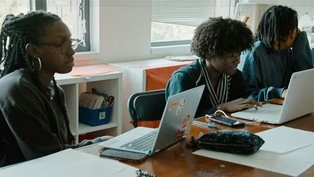
Video has Closed Captions
Students from Washington D.C. push themselves to become top-tier debaters and change their lives. (30s)
Providing Support for PBS.org
Learn Moreabout PBS online sponsorship












Support for PBS provided by: