
The issue the Lindsay Clancy jury will be deliberating
Clip: 8/27/2026 | 7m 7sVideo has Closed Captions
The central issue that the Lindsay Clancy jury will be deliberating
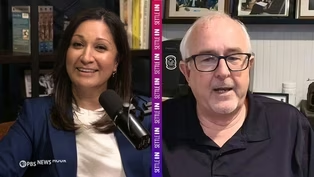
Jurors are deliberating in the murder trial of Lindsay Clancy, a case that has raised questions about maternal mental healthcare. Clancy does not deny killing her children, but she pleaded not guilty, arguing she can’t be held criminally responsible because the murders occurred while she was suffering from postpartum psychosis. Amna Nawaz discussed more with Camilo Fonseca of The Boston Globe.
Problems playing video? | Closed Captioning Feedback
Problems playing video? | Closed Captioning Feedback
Major corporate funding for the PBS News Hour is provided by BDO, BNSF, Consumer Cellular, American Cruise Lines, and Raymond James. Funding for the PBS NewsHour Weekend is provided by...
The issue the Lindsay Clancy jury will be deliberating
Clip: 8/27/2026 | 7m 7sVideo has Closed Captions
Jurors are deliberating in the murder trial of Lindsay Clancy, a case that has raised questions about maternal mental healthcare. Clancy does not deny killing her children, but she pleaded not guilty, arguing she can’t be held criminally responsible because the murders occurred while she was suffering from postpartum psychosis. Amna Nawaz discussed more with Camilo Fonseca of The Boston Globe.
Problems playing video? | Closed Captioning Feedback
Where to Watch PBS News Hour
PBS News Hour is available to stream on pbs.org and the PBS app.
Providing Support for PBS.org
Learn Moreabout PBS online sponsorshipAMNA NAWAZ: Members of the jury are now deliberating in the murder trial of Lindsay Clancy, the Massachusetts mother who strangled her three young children in 2023, before then attempting to kill herself.
Clancy's mental health has been the key issue in the five-week trial, which has drawn national attention and raised questions about gaps in maternal mental health care.
Clancy does not deny killing her children, but the former labor and delivery nurse has pleaded not guilty, arguing she can't be held criminally responsible for the murders because they occurred while she was suffering from postpartum psychosis.
Both the defense and prosecution gave their closing arguments this morning.
KEVIN REDDINGTON, Attorney for Lindsay Clancy: When the DA decides to charge someone with a crime, he has the burden of proof, his assistants have the burden of proof to prove that Lindsay at the time killed her children was not suffering from a mental disease or defect that caused her to have a lack of substantial capacity to appreciate, to know, to realize what was being done while she was in a psychosis.
JENNIFER SPRAGUE, Plymouth County, Massachusetts, District Attorney: All of the evidence that you have heard, even the experts that the commonwealth put before you say that she was suffering from mental illness and she tried to kill herself.
That's not the issue in this trial.
The issue is whether, at the time she killed Cora, Dawson and Callan she knew the difference between right and wrong, and whether she could conform her behavior to the requirements of the law.
AMNA NAWAZ: For more on the trial and the national conversation it sparked, we're joined now by Camilo Fonseca of The Boston Globe.
Camilo, welcome.
Thanks for joining us.
CAMILO FONSECA, The Boston Globe: Thanks for having me.
AMNA NAWAZ: So 21 days of testimony for more than 80 witnesses in this case, including family and first responders, Clancy's psychiatrists, her ex-husband.
What is the central issue that members of the jury will now be deliberating?
CAMILO FONSECA: So I think you heard it from the closing arguments there, is that what's at issue is not whether she killed her children, but whether she was criminally responsible, whether she was in a state where she was unable to control her actions.
And that's -- the defense's contention is that she wasn't.
She was in the throes of postpartum psychosis, that she heard voices, that she was not able to appreciate what she was doing rationally.
And the prosecution obviously is contesting that.
They're arguing that she was able to appreciate right and wrong, and regardless of whether she was struggling with her mental health at the time, that that is not enough, in the prosecution's eyes, to absolve her of criminal responsibility.
AMNA NAWAZ: This argument from the defense that she suffered from postpartum psychosis, as you mentioned, which is a very rare, but very severe mental health condition, what kind of evidence did they present to make that case?
CAMILO FONSECA: So they talked to a lot of doctors and psychiatrists that had been treating Lindsay Clancy in the months before the killings, in the months after she gave birth to Callan.
They were sort of picking apart what they saw as discrepancies in her treatment.
They talked to independent experts that were suggesting that she might have been overmedicated or that the -- her practitioners were not sharing information with each other.
It's going to be interesting to see whether the jury essentially buys that argument, because the prosecution has argued that her medical history is not at issue here.
It's what actually happened on the night of the killings.
So it's been the defense's point to make that actually all of this stems from the inability to spot the signs of postpartum psychosis, as you noted, very, very rare and very difficult to accurately diagnose.
But they argued there were signs and that she was actively seeking help up in the months before the killings.
AMNA NAWAZ: As we mentioned, this case has drawn significant national attention, everything from online conspiracy theories to crowds outside the courtroom, a number of women and mothers in particular that we have seen supporting Clancy sharing how they see their own postpartum struggles or mental health struggles reflected in this case.
I want to play for you just a little bit of sound from one of those women.
This is Mary Petitto.
Take a listen.
MARY PETITTO, Lindsay Clancy Supporter: Regardless of what happens in that house in January of 2023, we understand that Lindsay asked for help and it was not given.
And, as women, we understand that that was a failure.
And, regardless, she deserved better.
AMNA NAWAZ: Camilo, there is a confluence of factors in this case, both all these questions about postpartum and mental health care, but also questions of guilt and culpability, also just the very shocking nature of this crime.
How are members of the jury going to unravel all of this in their deliberations?
CAMILO FONSECA: It's going to be very complicated.
I mean, the questions of criminal responsibility versus mental -- her mental faculties at the time are not simple.
That's why we had almost three weeks of testimony from medical experts and people that treated her.
The finding that the jury is going to have to come to if they decide on a not guilty verdict will be not only that she was having mental health struggles, but also that she was unable to appreciate the rightness or wrongfulness of her actions or that she was unable to -- unable to obey the law.
So it's not simply a finding that she was dealing with mental health.
It's a finding that meets those specific criteria.
And that's been what the defenses have laid out.
AMNA NAWAZ: And if she is found guilty, what could Lindsay Clancy face here?
CAMILO FONSECA: She's facing up to -- if she is found guilty on first-degree murder, she will be committed to life without parole.
If she's found guilty of second-degree murder, which is to say not premeditated, she will be eligible for parole.
And then one big point of contention between the prosecution and the defense were instructions to the jury on a manslaughter charge, which Judge Sullivan ultimately gave.
And that would see a maximum of 20 years per count, so a maximum of 60 years, but there is no minimum.
So that would ultimately be up to the judge's discretion if they were to find her guilty of manslaughter and not of murder.
AMNA NAWAZ: All right, Camilo Fonseca of The Boston Globe, thank you so much for joining us tonight.
CAMILO FONSECA: Thanks again.
Craig Fugate joins Amna Nawaz on 'Settle In'
Video has Closed Captions
Craig Fugate and Amna Nawaz discuss climate change and disaster response on 'Settle In' (3m 13s)

Gaza's youth search for hope in devastated homeland
Video has Closed Captions
Gaza's traumatized youth search for glimmers of hope in devastated homeland (6m 45s)

How Mayo Clinic is using improv to engage dementia patients
Video has Closed Captions
How the Mayo Clinic is using improv to engage dementia patients (7m 13s)

How melting glaciers contributed to Himalayas flooding
Video has Closed Captions
How melting glaciers contributed to the flooding disaster in the Himalayas (8m 34s)

Jan. 6 rioters pursue new path for payments from Trump
Video has Closed Captions
Jan. 6 rioters pursue new path for payments from Trump administration (5m 4s)

Latvia's foreign minister warns of Russian sabotage acts
Video has Closed Captions
Latvia's foreign minister warns of Russian sabotage acts in Europe (7m 24s)

News Wrap: Trump signs order to rename Lake Ontario
Video has Closed Captions
News Wrap: Trump signs order to rename Lake Ontario as Lake America (7m 3s)
Providing Support for PBS.org
Learn Moreabout PBS online sponsorship
- News and Public Affairs

FRONTLINE is investigative journalism that questions, explains and changes our world.

- News and Public Affairs

Today's top journalists discuss Washington's current political events and public affairs.



 New Episode
 New Episode



 New Episode
Support for PBS provided by:
Major corporate funding for the PBS News Hour is provided by BDO, BNSF, Consumer Cellular, American Cruise Lines, and Raymond James. Funding for the PBS NewsHour Weekend is provided by...