
Maternal Instinct
Season 9 Episode 6 | 26m 24sVideo has Closed Captions
Motherhood takes many forms, born of love, loss, and the courage to embrace the unpredictable.
Motherhood takes many forms, born of love, loss, and the courage to embrace the unpredictable. Joy proves that family is built through resilience as much as biology; Trish becomes both Mum and Dad after the sudden loss of her husband; and Julia finds strength in letting go after a pregnancy heartbreak. Three storytellers, three interpretations of MATERNAL INSTINCT. Hosted by Theresa Okokon.
Problems playing video? | Closed Captioning Feedback
Problems playing video? | Closed Captioning Feedback
Stories from the Stage is a collaboration of WORLD and GBH.
Maternal Instinct
Season 9 Episode 6 | 26m 24sVideo has Closed Captions
Motherhood takes many forms, born of love, loss, and the courage to embrace the unpredictable. Joy proves that family is built through resilience as much as biology; Trish becomes both Mum and Dad after the sudden loss of her husband; and Julia finds strength in letting go after a pregnancy heartbreak. Three storytellers, three interpretations of MATERNAL INSTINCT. Hosted by Theresa Okokon.
Problems playing video? | Closed Captioning Feedback
How to Watch Stories from the Stage
Stories from the Stage is available to stream on pbs.org and the free PBS App, available on iPhone, Apple TV, Android TV, Android smartphones, Amazon Fire TV, Amazon Fire Tablet, Roku, Samsung Smart TV, and Vizio.
Providing Support for PBS.org
Learn Moreabout PBS online sponsorshipJOY BEAULIEU: We weren't thinking about having a mortgage and having endless amounts of student loan debt.
We were ready to become Mommy and Mama.
TRISH KEATING: I remember looking at my children that day, thinking they'd never recover from this.
How was I going to be Mum and Dad?
JULIA LECHNER: He asks, "Are you married?"
I say, "Yes."
"Do you have kids?"
"No."
"When will you have kids?"
(laughter) THERESA OKOKON: Tonight's theme is "Maternal Instinct."
Maternal instinct is powerful, but it's not always tidy.
It can look like a fierce protection, like a gentle presence.
It can look like longing, like letting go, like loving through heartbreak.
Tonight's tellers are here to remind us of the many ways that people mother.
Sometimes by choice, sometimes by chance, and often in the midst of hope mixed with hardship.
♪ ♪ BEAULIEU: My name is Joy Beaulieu.
I live in Reading, Massachusetts.
I'm a wife and a mom, and I own a hair salon.
So, what role does storytelling play in your day-to-day life?
Oh, that's, like, all we do in the salon, right?
(Okokon chuckles) Is, everyone sits down.
I know everything about everybody before anybody else does.
And we all share stories through each other's chairs and across the room.
And everyone's, like, "Oh, sorry, I didn't mean "to interrupt you... (both laugh) ...but let me tell you this great thing."
And what was it like to go, then, from that sort of casual storytelling to preparing a story to tell on stage in this way?
It's a lot of work for me, to feel like it flows out onto paper, but then at that point, I have to get it back into my brain and then back out of my mouth again.
Mm-hmm.
So, it was an interesting process, sort of shifting to recording myself speaking, so that I could then listen to myself saying it over and over again, and then writing it out, trying to remember everything.
And it was a, an interesting technique that worked a little bit better.
I'll never forget the first time I had sperm delivered to my house.
(laughter) Growing up, I always knew I wanted to be a mother.
I never gave much thought about how that would happen.
I always imagined I would... Shopping for baby clothes and first-day-of-school clothes, prom dresses, and wedding dresses.
Shopping for sperm was never on that list.
(audience chuckles) So when I met my wife, and we knew we wanted to have a family, we decided that she would carry our baby.
We were so excited to move in this direction.
And we started shopping for a sperm donor.
We knew that we did not want a known donor.
We wanted someone who was anonymous.
We felt like two loving parents was enough for us.
We pored over medical records, trying to read between the lines on the nurse's help section comment on the donor information card, searching for words like "handsome" and "funny" and "kind."
We wanted them to be the perfect blend of the two of us.
(laughter) With my wife being Caucasian and me being of mixed race, we wanted to look like a family.
So we made our choice, we placed an order, and we waited.
The first shipment would come according to the mom-to-be's cycle.
So when the U.P.S.
delivery pulled up and brought us a three-foot-tall cardboard box that was about a foot square, we were a little surprised.
And inside the box was a tank about this tall, filled with dry ice, one ounce of sperm... (audience chuckles) ...directions, and a turkey baster.
(laughter) Now, the U.P.S.
driver definitely knew who we were by the shipper's address.
Nothing says "lesbians" like "cryobank."
(chuckles) (laughter) The first thing we wanted to do was actually learn how we could do this at home, so we did a ton of internet research.
And the internet suggested that a woman be relaxed in order for artificial insemination to be successful.
Now, we assumed that the internet was suggesting that we show our love for one another in a physical way.
But let me tell you, there is absolutely nothing romantic about defrosting one ounce of sperm in your armpit for 15 minutes while giggling like a woman with sperm in her armpit.
(laughter) I'm gonna say we laughed a lot and we hoped for the best.
That first time didn't work.
It was hard for me, because I was the optimistic partner.
I was supportive, I was here as the cheerleader.
And my wife, this was her body.
And so while I was holding on to this intense optimism, she had so much disappointment.
We tried three cycles at home in this way to get pregnant, unsuccessfully.
And some of them didn't actually happen at home.
There was one time where we had a family wedding and it was in Rochester, New York.
So, we had our delivery, and we packed it up in the backseat of the car and buckled it in... (laughter) ...figuring it was good practice for a car seat someday, and we drove to Rochester, New York-- eight hours with sperm in the backseat.
(laughter) To complicate things more, my aunt had adjoining rooms with us on that trip.
So while Carolyn had her legs up the wall with her cervix tilted at just the right angle so that the swimmers could do their thing for 15 minutes, my aunt began knocking on the door, asking, could she borrow our hairspray?
"And, oh, by the way, your cousin doesn't like her hair.
Can you please fix it?"
(laughter) We thought for sure we would get pregnant right away.
We had couple friends that had gotten pregnant immediately, right out of the gate.
One came home on lunch and got pregnant, doing the same thing we did, and then went back to work.
(laughter) But for us, we weren't so lucky.
So we decided we would visit the Boston-based clinic that had a long history of supporting the LGBTQ community.
This was going to double our cost.
As it stood, with what we were doing, the cost of our specimen, including delivery, was $600, which was about half of our monthly mortgage payment.
But we weren't thinking about the logistics of having a mortgage and having endless amounts of student loan debt that was never going to go away and no savings account.
We were ready to become Mommy and Mama.
So when we moved on to the clinic, we knew our cost would double.
And we would have to travel in one day, and then the next day.
It was about an hour from our home each way.
We did that 12 times.
And each time, I tried to hold on to that optimism and be that supportive partner, and say, "It's going to be great.
This might be the time."
And each time, my wife endured that crushing disappointment.
At this point, it had been about three years since we had started, and she looked at me and said... (chuckling): "Batter up."
(laughter) So I made an appointment and I went to go see a fertility doctor, as I've always had an inconsistent cycle.
And it was found that I would need help in order to get pregnant.
Of course I did.
So we started that process.
We had gone through multiple donor selections at this point, and we started the process and I got pregnant right away.
And I was pregnant for a couple of weeks.
And then the second time didn't work.
And on the third time, I was 34 years old, I gave birth to our son.
(chuckles) (applause) We were in love with him.
We are in love with him.
And we were in love with our lives.
It was 2008, and it was kind of a big year.
And the biggest question we had on our minds now was, do we do it again?
Do we try for a second?
So we went back and forth and back and forth, and we decided Carolyn would try again.
So we went to the fertility clinic, and it took exploratory surgery and two rounds of IVF.
And at 36 years old, she gave birth to our daughter.
(applause and cheering) It was a long road for us.
Took about four years.
There was so much laughter and so much disappointment.
And I can't say that I wouldn't change parts of my journey to motherhood, but I can say I would never want to journey motherhood without my wife, Carolyn.
Thank you.
(applause and cheering) ♪ ♪ KEATING: My name is Trish Keating.
I was born in Dublin, Ireland, where I still live, and I work in healthcare.
And what drew you across the ocean, over, over here, to tell this story?
KEATING: I first heard about Stories from the Stage online, and something popped up in my feed or something about maternal instinct.
You know, I probably was sitting with a glass of wine and I clicked it, and wrote a little bit, and then submitted it.
And then, somebody contacted me to say they liked it, and would I be part of the seven that would go on Stories on the Stage?
(Okokon chuckles) Which I was shocked at.
And so, when you were crafting this story to tell, were there any particular challenges or insights that you found yourself encountering?
KEATING: Yeah, I was, I was nervous, because it's, you know, a lot to do with how my children were feeling and what they were going through in different times.
And I asked them first, and, you know, and I explained to them what I would be talking about.
Um, but they were more than happy for me to talk about it.
I flung a purple shirt and a pink tie into the boot of my car.
I think that's what you call a trunk here.
(audience chuckles) It was a present for my husband.
It was his birthday the next day.
I was already regretting it.
I never seemed to get the presents for Rory quite right.
He, on the other hand, a master at buying presents for me.
I knew for my birthday and Christmas a couple of months later there would be piles of presents, each better than the last.
My son Jack would count presents under the Christmas tree, knowing there were a lot more "To Mum, Love, Dad" than the other way around.
My daughter Holly would be smiling and giggling like she did most days.
Holly and Jack's granny, Rory's mum, would be sitting beside them, delighted to be involved in the surprises.
She was a big part of our lives.
I was going through all I had to do in my head.
Make a birthday cake, wrap the present, pack the suitcases.
We were going to my sister's wedding abroad in two days' time.
Hence the purple shirt and the pink tie.
Rory never got to wear the purple shirt or the pink tie.
It remained in the boot for an entire year.
He died suddenly on his 47th birthday.
I remember looking at my children that day, thinking they'd never recover from this.
How was I going to be Mum and Dad?
They didn't look like a 15-year-old and a 13-year-old.
They looked like two small children again, and I couldn't protect them.
After Rory's funeral, the three of us, when it should've been four, traveled to my sister's wedding.
It was hard saying goodbye to Rory's mum, but it was only a couple of days.
I put one foot in front of the other, stood in for the family photo, forcing some kind of smile, knowing this photo was going to be around for a long time.
On the way back from the airport, my brother couldn't look at me.
I thought, "This is so hard for him, too."
Little did I know.
On the other side, Holly and Jack were ushered off with the promise of McDonald's with my sisters.
My brother pulled me aside and said that Holly and Jack's granny, Rory's mum, had died while we were away.
(audience murmurs) The drive home was unthinkable, knowing in 30 minutes, I now had to tell Holly and Jack that somebody else very important to them had also died.
And if I thought I couldn't help them a couple of days ago, it was now worse than ever.
Would they go back to school?
Would they ever be happy again?
At that point, I thought no.
They did go back to school.
They seemed happy.
My family and friends were amazing, going over and above.
But I still struggled with the thoughts that I wasn't doing enough, not getting it quite right.
Several years later, Holly became very ill.
Her airway was in danger of closing over.
She needed to go to hospital.
As we were preparing to go, Jack calls.
"Mum, I think I've broken my arm quite badly."
You've got to be kidding me-- which I actually think I said out loud.
(audience chuckles) The dilemma: they both needed to go to hospital on the same day.
Two different hospitals, miles from each other.
I dropped Jack off, desperately wanting to split myself in two, and continued on to the next.
Jack was due for surgery that morning, so I thought he'd be asleep for most of the day.
As I sat with Holly, she was getting worse.
I ran outside to put money in the meter and to call Jack.
He was still waiting, fasting.
It was midday.
Holly was moved from room to room, surrounded by doctors and nurses.
They were trying to find a vein to get antibiotics in her.
There were needles in her neck, in her ankles, in her wrists.
I was holding her hand when a more senior doctor came in and asked me to leave.
Standing in the stairwell, it was cold and silent.
I was looking down a wide staircase.
I could see no one.
I rang Jack.
It was 6:00 in the evening.
"Mum, I'm still waiting.
I'm so hungry and thirsty.
It's so crowded here."
"I'll be there as soon as I can."
In my head, I'm thinking, "I should be there now, demanding that he's brought in."
I could hear voices from the room Holly was in.
Standing on the stairwell, I now knew I was there for neither of my children.
The next two days were spent mainly in traffic or looking for parking, grabbing as much time as I could with both of them.
Thinking again of the effect this was having on them.
I hadn't seen Holly smile for days, and I was sure Jack was worrying.
Jack had his operation later that night and came home in a cast two days later.
Holly came home the same day and had her tonsils out the following week.
I did the best I could doing the job of two parents, but still felt it wasn't enough.
Christmas Day 2023.
The first without Holly and Jack.
They're both living abroad.
I'm in my mum's.
It's the afternoon, we've just had dinner.
I'm squeezed in between my sisters-in-law and my sisters on the couch.
Everyone else has grabbed a chair or a piece of the floor.
We're chatting, waiting to open our presents.
We have a tradition that started when I was a child, that every present is opened individually, it's valued, and whoever gave it is thanked.
We've had to cut back on presents over the years because there's now so many of us.
We have a very strict "one present for the adults, two for the children."
The present-opening can take hours, but we love it.
Sometimes there's extras.
My mum gets extras, but that's allowed.
This year, a box was planted on my lap.
I knew it was an extra.
It was a present from Holly and Jack.
There was an envelope sellotaped to the outside.
A letter from Jack.
I thought, "Jack doesn't write letters."
(laughter) In fact, what 25-year-old does?
(laughter) I'd be lucky to get a text.
I started reading: "Dear Mum, "I've been thinking of saying this to you for a while."
There was silence.
This was going to be emotional.
"Maybe read this when you're on your own," my mum said.
I continued.
Jack talked about the day his dad died, and how I told them both, saying we're still going to be a great family.
Did I say that?
He wrote about the hospital.
"Mum, for two days, you jump between hospitals, "spending hours in waiting rooms and wards, looking after myself and Holly."
I thought of the stairwell and my thoughts that day.
"When we came home, we gave you a bottle of wine, "which you were shocked at.
"You gave us the world, expecting nothing in return, when you deserve so much more."
The letter ended: "So, Mum, "if you're wondering if I think we are a great family, "you didn't make it feel like I had one parent, "nor did I feel like I had two.
"You made it feel like I had ten.
So thank you."
It took me a while to digest what I was reading.
It was the opposite of what I had thought.
I was surprised, relieved.
I knew Jack and Holly were happy, and I was so proud of them.
But now I knew I had done enough.
Thank you.
(applause and cheering) ♪ ♪ LECHNER: My name's Julia Lechner.
I'm from New Jersey and live in Los Angeles, and I'm a writer and storyteller.
I understand that you got started in journalism.
Can you tell me a bit about how that began?
I had a previous career as a newspaper reporter.
I've always loved storytelling and was comfortable talking to strangers as a young person.
So I like asking people questions about their lives and learning more about them.
A lot of times, people that I would interview were really humble, and so I'd say, "I'd like to interview you "about the fact that you work on watersheds in Southern New Jersey."
And they might say, "I'm not that interesting."
And then once I would ask them a few questions, I'd learn everyone has fascinating parts of their life to share.
And something I loved about that was being able to draw that information out of people who might not be accustomed to sharing their stories, and then telling that story to a wider audience.
And so how did you get into telling your own story, especially on stage in this way?
I've always enjoyed performing, and I, I come from a family of storytellers.
My dad likes to tell stories, as well, and had the opportunity while living in Los Angeles to try a storytelling show for the first time and fell in love with it.
And I've been performing my own personal stories at shows for over a decade now.
And I've also had the opportunity to coach and mentor others who'd like to try storytelling, too.
We're driving to the Los Angeles airport, and my rideshare driver, Farouk, is making all the small talk that drivers often do.
We're not really connecting, which is fine.
We're just trying to get to L.A.X.
But I can tell he's trying to find a thing that we can bond over.
He asks, "Are you married?"
I say, "Yes."
"Do you have kids?"
"No."
"When will you have kids?"
(laughter) It's something women of a certain age hear a lot.
It's never "if," it's always "when."
And before I can even think about it, I tell Farouk, "Well, actually, my husband and I just found out that I'm pregnant."
Farouk's whole demeanor changes.
He's acting like there's a celebrity in his car.
(laughter) And he says, "Oh, my gosh, "there's a pregnant woman in my car.
This is so exciting."
And as he's talking, I'm thinking, "Why did I just tell Farouk I'm pregnant?"
The only people that know are my doctor and my husband.
I haven't even told my family yet.
I'm flying home to New Jersey and planning to tell my parents tomorrow, on Mothers' Day.
And now I've told Farouk first.
(laughter) He's thrilled, and... (laughter) I wish I could be, too.
But I'd been pregnant before, the year prior, and it didn't end well.
We never got to have that moment where you share the happy news with people.
I told my husband on his birthday.
A few days later, we found out we'd be losing it.
It was ectopic, and not developing correctly anyway.
My doctor gave me a pill to help end it, and we moved on.
So now we're pregnant again, but it doesn't feel truly happy.
It just feels like I know how pregnancy ends for me and it's not happy news.
But I want to believe I can be happy, because Farouk is, like, really freaking pumped.
(laughter) He tells me he's a grandfather now, but he lived in India when his children were little, and he talks about how they didn't have a bassinet when his kids were babies.
He would hold on to one of their arms or legs while they were sleeping next to one another, so he knew they didn't wander off or roll over.
And he's sharing these little pieces of his history to connect with me about what it will be like to be a parent.
Then he starts giving me the unsolicited advice that a lot of parents receive, like, "Make sure you breastfeed as long as you can.
It's really important."
And I just tell him, "I appreciate it, Farouk," because I don't really want to talk about my boobs with my rideshare driver.
(laughter) We're bonding over this moment together, and it's unexpected on the way to L.A.X.
And as we get closer to the airport, I start to not feel great.
It's not morning sickness, just my standard stress-induced I.B.S.
As we get closer to the airport, I know I'm not going to make it to my terminal.
So I tell him, "Just take me to Terminal One.
"I'll go to the bathroom and get to my terminal after.
I, I really don't feel well."
I know he's probably thinking I'm sick because I'm pregnant, and I guess it doesn't matter either way.
But he says, "No, we're in this together.
"Go in that terminal, go to the bathroom.
I'll be here, I'll be here."
And I'm, like, "Farouk, I'll just take my stuff."
And he says, "No, I'll be here."
So I take my purse, I leave all of my luggage in his vehicle, and I run in.
I'm convinced I'll come back outside, and Farouk and my suitcase will be long gone.
They do not let you stay at the curb for more than ten seconds at L.A.X.
But by some miracle, he's still there, arguing with a cop, refusing to leave.
I get back in his car, and he looks at me in the rearview mirror as if to say, "You okay?"
I buckle up and all I can say is, "Farouk, thank you."
And he says, "Of course.
Happy Mothers' Day."
And then he drives me to my terminal, helps me with my bags, and wishes me well on my travels and in my life, and we, you know, never see each other again.
Five-star rating.
(laughter) The next day, I set up a video call with my husband in L.A.
and my parents, who I'm visiting in New Jersey, and we tell them I'm pregnant.
So I practiced with Farouk, and that made it a little easier.
A few days later, on the last day of my visit, I wake up in a pool of blood.
And I already know it's ending.
I'm losing another pregnancy.
I know what comes next.
The appointments, the waiting, the slow unraveling of something that's already over.
And I know, deep down, I will never do this again.
I want my life back.
A life I loved before I started trying to add children to it.
It's enough, and it's complete without having kids.
I just want to feel like myself again.
My mom washes the sheets.
My parents are quiet.
They offer to let me stay longer, but I just want to go home, and their home isn't my home anymore.
I spend the day mindlessly watching reruns on their couch until they drive me to the airport.
I fly home, bleeding, and my husband and I wait for weeks for the miscarriage to fully pass.
And eventually, it does.
I'm just me again.
Only now I know what it feels like to try so hard for a life you thought you'd have, and decide it's ultimately best to walk away.
To have that occasional pang of "what if?"
even though I know I made the right choice to stop pursuing parenthood.
I've never told anyone about Farouk before, not even my husband.
It felt strange to share a pregnancy story when there wasn't a baby or happy ending to show for it.
But even though we'll never see each other again, and he doesn't know how life turned out for me, there is still a happiness in that little moment when someone showed up for me during a really difficult chapter in my life.
A happy ending doesn't have to mean I became a mom.
It can mean someone was there for me when I really needed it.
To show me kindness.
To say, "We're in this together.
I'll be here."
And to really mean it.
Thank you.
(applause and cheering) ♪ ♪
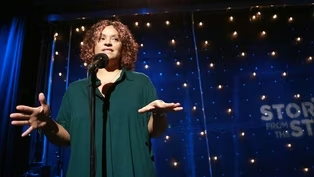
Video has Closed Captions
Preview: S9 Ep6 | 30s | Motherhood takes many forms, born of love, loss, and the courage to embrace the unpredictable. (30s)
Providing Support for PBS.org
Learn Moreabout PBS online sponsorship

- Arts and Music
The Best of the Joy of Painting with Bob Ross
A pop icon, Bob Ross offers soothing words of wisdom as he paints captivating landscapes.











Support for PBS provided by:
Stories from the Stage is a collaboration of WORLD and GBH.