Across Indiana
The Black Speed Kings of Indiana
Clip | 11m 41sVideo has Closed Captions
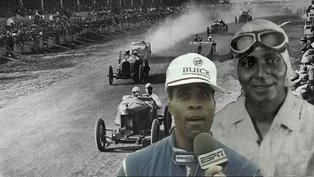
Segregation at the Indy 500 led Black racers to create the Gold and Glory Sweepstakes.
Debuting in 1911, the Indianapolis 500 has cemented itself in the fabric of American culture. But that culture was not always shared. In its early days, the Speedway was segregated, and drivers of color were banned. That exclusion inspired these “Speed Kings” to create their own racing spectacle from 1924 to 1936. In 1996, Across Indiana producer Todd Gould took us trackside with the heroes of the
Problems playing video? | Closed Captioning Feedback
Problems playing video? | Closed Captioning Feedback
Across Indiana is a local public television program presented by WFYI
Across Indiana
The Black Speed Kings of Indiana
Clip | 11m 41sVideo has Closed Captions
Debuting in 1911, the Indianapolis 500 has cemented itself in the fabric of American culture. But that culture was not always shared. In its early days, the Speedway was segregated, and drivers of color were banned. That exclusion inspired these “Speed Kings” to create their own racing spectacle from 1924 to 1936. In 1996, Across Indiana producer Todd Gould took us trackside with the heroes of the
Problems playing video? | Closed Captioning Feedback
How to Watch Across Indiana
Across Indiana is available to stream on pbs.org and the free PBS App, available on iPhone, Apple TV, Android TV, Android smartphones, Amazon Fire TV, Amazon Fire Tablet, Roku, Samsung Smart TV, and Vizio.
Providing Support for PBS.org
Learn Moreabout PBS online sponsorshipThrough the north shoot turn number four.
Push the car below the line and here he comes off for a high exit, stays high in the racetrack and the checkered flag is up for Willy T. Ribbs.
In 1991, Willy T. Ribbs became African- American to qualify for Indianapolis 500.
His accomplishment was historic, the pinnacle of the remarkably rich yet little known legacy that preceded Ribbs by nearly seven decades.
The Gold and Glory Sweepstakes was the race that belonged to the colored people.
It was ours.
There was truly glory attached to winning it.
Most of the black drivers over the country would come when they had those races.
And, it was just fun.
It's fun to be there and to see.
This is the story of America's first African American race car circui and the organization's greatest The Gold and Glory Sweepstakes where the nation's top African A drivers competed in hopes of win for themselves and glory for the They call my grandfather “Pres”.
He was the president of the, colored race at tha they had here at the fairgrounds It was his drea and his idea that they have one.
And he was successful in pulling it off.
William Rucker was an ardent race fan.
The thrills of the Indianapolis 500 sparked a keen passion for Rucker.
One of the city's most prominent black leaders.
But like most of society in the the Speedway was segregated.
Rucker knew that for blacks to compete in auto racing, they needed their own organizati a colored racing circuit that toured major cities throughout the Midwest.
During that time, there were so many obstacles that he faced even in having the So, you know, it was it was one of the things, many things that he overcam now how he did it, I don't know, but he had the charism to accomplish things like that.
My grandfather was also a survey land surveyor, and in being a land surveyor and other jobs that he did, he got to know the people who were the real mo shakers of the community, both black and white and those who were even the wealthy people.
He got to know the people at the in the earlier jobs that he had he became a, a part of the races And so because he knew these peo when this dream came to him about having an automobile racing association, he went to some of these people who he knew who were the movers and shakers in both the communities.
And because of that, they he began to share with the his dream and shared with them how it could be successful.
Rucker approached noted race promoter Harry Earl.
Together the two gathered a group of skilled financial and promotional wizards, to for the Colored Speedway Association in 1924.
With Pres Rucker as their leade the group staged an annual event exclusively for black drivers and mechanics.
Pres Rucker had the knowledge maybe not all the money that he but he had the personal strength to pull together the people who pull together black people.
And he had some white peopl who who believed in him and help support him to get the Colored Speedway Association going.
So he, was he had the smarts to do it, to organize it.
And then once he got organize and the people in the community responded to him, and then and t then on, it existed and became a success.
August 2nd, 1924.
Today, colored speed team will compete for gold and glory during the greatest out of speed ever undertaken by members of our group.
A 100 mile grueling grind to be run on the dir track at the State Fairgrounds.
Young men of our race now have that heretofore has been denied.
It is the dawn of a new opportun another step forward.
The brushing away of another bar another obstacle met and surmounted by our group in the realm of sports.
Indianapolis Freeman.
This is just exciting to me as a young girl.
It was it was thrilling to me.
I love to hear the drum of the m It's it's a thrilling sound just like it is at the 500 mile You hear those?
But those motor racing against give you a kick.
Really.
Fireworks parades in the crowd of 12,000 spectators created a mood of celebration in the city.
As the flag dropped the engines roared and the dust as Indiana ushered in a new race and a new era for African Americans.
All the drivers problems in on d tracks was the dust.
Those in front of you kicking up so much dust that you really couldn't see th you just corniest was following You tried to watch the poles there was poles around the track and you watch the poles and see how far you was in from the fence.
A grocer by trade, Leon Al Warren, was one of the Gold a fiercest competitors.
He shared a special bond with fe racers on their Midwestern circuit.
One of Warren's friends was Sumn Red Oliver, who once earned the pole positi at the annual fairgrounds event.
Now 95 years old, Oliver reflect on the joys of the Gold and Glory Sweepstakes.
The best and most colorful racer of the e was Charlie Wiggins, known as the Negro Speed King.
He was always interested in auto mechanics, but he was, at one time, he... He shined shoes and, that this one gentleman that, he was working on notice how he would be interested in the car that was going by the that he would make.
And so he he, broached the subje the name of becoming it, you know, having no garage, more or less.
And, and that's what started Uncle Charlie out.
Wiggins built his own cars from handcrafting each part as a celebrated driver and mecha he often coached aspiring young drivers during t careers, even noted white driver of the era, such as Harry McQuinn in 1934, Indianapolis 500 champion Bill Cummings consulted Charlie on driving techniques and mechanical procedures.
While the Gold and Glory brought great thrills it also brought great tragedy.
The 1929 race promised to be the biggest event in black racing history, with record crow and more than $2,500 in prize money.
But a horrid accident on the 27th lap marred the festive occasion.
Edward Grice, a World War On veteran and mechanic from Texas, drove through a cloud of dust and slammed into the driver in front of him at more than 80 an hour, the collision sent his race car into a deadly series of somersau that threw Grice more than 10 feet into the air.
July 11th, 1929.
There were impressive funeral services held today for Edward H. Grice, who died from the effects of injuries received in the 100 mile speed championship.
With the tenacity of a determine fighter, Grice undaunted by two previous futile attempts, tried again at the Fairgrounds Speedway for the last time evermore.
Negro race drivers lost a true sportsman with the passing of Grace, he was a credit to the game.
Indianapolis Recorder.
Another tragic day came in 1936, when a 13 car threatened the life of racing gr Charlie Wiggins.
My car was six car into into the ring, but now they had to take the ste wheel off for me to get in the car.
But I don't know how I got out t so quick.
I got out of here and and ran o and then jumped over the fence and I heard Charlie hollering “Take it off my leg, take it off my leg!” in so then I when I tried to lift t about time, I tried to lift the I heard him, there's motors coming.
So I jumped back to the fence and sure enough, one of them it hit Charlie's car and knocke about as far from here to there.
With him hanging here.
Charlie Wiggins lost his leg in the 1936 race.
After he was released from the Charlie went home and fashioned a custom made wooden leg for him then returned to work at his garage.
There, he continued to train you mechanics and drivers for many years.
It was this kind of spirit that the organizers and drivers of the Gold and Glory Sweepstakes to unprec success in the sporting world.
It was a social event, and it was a great honor to be a part of it.
And because it was successful and because there were people who who won these races were her It's just a kind of the love of and, you know, just doing something.
I think it had to be a people with just an active spirit did want to be doing some And I think that's it.
For more Across Indiana stories, go to wfyi.org/acrossindiana
 New
NewUnpacking the World of Lunch Box Collecting
Video has Closed Captions
Clip | 5m 5s | Dave Stoelk unpacks the world of vintage lunch box collecting. (5m 5s)
Defining and Recognizing "Black Art" with a Hoosier Artist
Video has Closed Captions
Clip | 5m 14s | Artist William Taylor examined “black art” and worked to elevate African American artists. (5m 14s)
 Now Playing
The Black Speed Kings of Indiana
Video has Closed Captions
Clip | 11m 41s | Segregation at the Indy 500 led Black racers to create the Gold and Glory Sweepstakes. (11m 41s)
Video has Closed Captions
Clip | 6m 9s | The last of the Buffalo Soldiers (6m 9s)
Video has Closed Captions
Clip | 5m 32s | “Terminating” the Indiana poaching issue with some clever tech. (5m 32s)
Chesterton Wizard of Oz Festival
Video has Closed Captions
Clip | 6m 32s | A vintage look back the the Chesterton Wizard of Oz Festival (6m 32s)

Remembering the Indianapolis Clowns
Video has Closed Captions
Clip | 8m 17s | The Indianapolis Clowns were pioneers who challenged segregation in baseball. (8m 17s)
Video has Closed Captions
Clip | 4m 54s | Raggedy Ann is a classic and was created by a Hoosier! (4m 54s)
Video has Closed Captions
Clip | 3m 36s | Butler Ballet has been performing The Nutcracker since 1962. (3m 36s)
Video has Closed Captions
Clip | 6m 31s | Central Indiana has played a great part in gospel music. (6m 31s)
Video has Closed Captions
Clip | 3m 53s | The toboggan run at Pokagon State Park brings out 77,000 sledders every year. (3m 53s)

The Tragedy of the USS Indianapolis
Video has Closed Captions
Clip | 8m 37s | The sinking of the USS Indianapolis was the Navy’s greatest disaster at sea. (8m 37s)
Video has Closed Captions
Clip | 5m 45s | The Turkey Trot Festival in Montgomery, Indiana is a sight to behold. (5m 45s)
The Murat Temple’s Biggest Secret
Video has Closed Captions
Clip | 5m 26s | The tale of the ghost that haunts the Murat in downtown Indianapolis. (5m 26s)

Video has Closed Captions
Clip | 3m 52s | Sandhill Cranes make a pit stop in Indiana on their great migration down south. (3m 52s)
How Do Hoosiers Make Apple Cider?
Video has Closed Captions
Clip | 4m 3s | There’s simply something special about Indiana apple cider. (4m 3s)
Video has Closed Captions
Clip | 4m 10s | The Indiana State Fair has a wide array of queens from all over the state. (4m 10s)
Video has Closed Captions
Clip | 6m 41s | The story of the original home of the Indianapolis Indians, Bush Stadium. (6m 41s)
Video has Closed Captions
Clip | 4m 59s | Holiday World in Santa Claus, Indiana was America’s first theme park. (4m 59s)
Video has Closed Captions
Clip | 4m 39s | Zaharako’s is a Columbus, Indiana classic for good reason. (4m 39s)
Video has Closed Captions
Clip | 5m 32s | The story of legendary Indiana high school basketball star and trailblazer Oscar Robertson. (5m 32s)
Video has Closed Captions
Clip | 4m 57s | Donaldson’s Finer Chocolates in Lebanon, Indiana is just as magical as Wonka’s Chocolate Factory. (4m 57s)
Video has Closed Captions
Clip | 5m 10s | Kids from around the world come to Culver, Indiana for summer camp. (5m 10s)
Video has Closed Captions
Clip | 5m 9s | The splendor of Frank Lloyd Wright’s work is just down the street. (5m 9s)
Video has Closed Captions
Clip | 4m 52s | The life of Mexican migrant workers in southern Indiana. (4m 52s)

Video has Closed Captions
Clip | 5m 9s | Where the precision of art meets the devotion of faith (5m 9s)

Video has Closed Captions
Clip | 6m 55s | Come on, bro! Pack the sunscreen and beer because we're going to...the Indiana Dunes? (6m 55s)
Video has Closed Captions
Clip | 7m 3s | Let’s go, Jeeps?! Let’s go, Hot Dogs?! (7m 3s)
Video has Closed Captions
Clip | 4m 27s | St. Patrick’s Day brings fun, but it’s also a celebration of Irish culture. In 1995, Across Indiana (4m 27s)

Video has Closed Captions
Clip | 5m 21s | In 1993, Across Indiana producer, Titus Rush, visited a Hoosier buffalo farm. (5m 21s)
Video has Closed Captions
Clip | 9m 52s | Another Indiana?! In 1994, Across Indiana explored its surprising similarities to our own state. (9m 52s)
Video has Closed Captions
Clip | 4m 51s | No date on Valentine’s Day? You’re not alone! Let’s revisit 2006 to explore Cupid’s favorite holiday (4m 51s)
Video has Closed Captions
Clip | 4m 26s | In 1994, David Stoelk visited a Kokomo club where llamas dance too! (4m 26s)
Video has Closed Captions
Clip | 8m 36s | In 1995, Todd Gould highlighted how Robert F. Kennedy delivered the news of Dr. King’s death. (8m 36s)
Video has Closed Captions
Clip | 7m 7s | As Trump’s inauguration nears, Across Indiana explores presidents' notable and obscure health issues (7m 7s)
Video has Closed Captions
Clip | 5m 20s | In this classic episode of Across Indiana Titus Rush explores Ski World in Nashville, IN. (5m 20s)
Video has Closed Captions
Clip | 5m 51s | An elderly disco sensation shares the secret to his happy life. (5m 51s)
Video has Closed Captions
Clip | 6m 1s | The moment when Wabash, IN saw the light, before everyone else. (6m 1s)
Video has Closed Captions
Clip | 9m 54s | The Head of Christ, how an image born from creative desperation went on to reach billions. (9m 54s)
Video has Closed Captions
Clip | 5m 38s | From a quirky idea to a thriving business: the story behind The Bentcil™ Company. (5m 38s)
Video has Closed Captions
Clip | 4m 38s | Join Russell Levitt's beer journey in Bloomington on Across Indiana. (4m 38s)
Video has Closed Captions
Clip | 7m 38s | In this classic Across Indiana we explore the great squirrel invasion in Salem, IN. (7m 38s)
The Music Maker | Classic Across Indiana
Video has Closed Captions
Clip | 5m 20s | Saxophonist Jimmy Coe's fantastic journey from high school grad to jazz legend. (5m 20s)
Video has Closed Captions
Clip | 5m 12s | From church newsletter to vital Black newspaper, the Indianapolis Recorder's journey. (5m 12s)
Video has Closed Captions
Clip | 5m 12s | Historian Rea Ferguson uncovers the hidden Black history of Indiana's rural communities. (5m 12s)
Video has Closed Captions
Clip | 4m 41s | Explore Madam Walker's legacy and the iconic Madam Walker Theatre. (4m 41s)

Video has Closed Captions
Clip | 4m 12s | Remembering the pottery, simplicity, and unique perspectives of Richard & Marj Peeler. (4m 12s)
The Milkman Cometh | Classic Across Indiana
Video has Closed Captions
Clip | 8m 12s | Dave Stoelk walks in the shoes of one of the last remaining milkmen, Don France. (8m 12s)
Not-So-Modern Medicine | Classic Across Indiana
Video has Closed Captions
Clip | 4m 13s | The Indiana Medical History Museum holds many oddities from a time long gone. (4m 13s)
Crossing the Language Barrier | Classic Across Indiana
Video has Closed Captions
Clip | 5m 10s | In this 2006 episode, William Rasdell used photography and technology to celebrate life. (5m 10s)
Providing Support for PBS.org
Learn Moreabout PBS online sponsorship












Support for PBS provided by:
Across Indiana is a local public television program presented by WFYI