
Iran targets ships in Strait of Hormuz, raising energy fears
Clip: 3/11/2026 | 5m 9sVideo has Closed Captions
Iran targets ships in Strait of Hormuz, raising global energy fears
The Persian Gulf energy crunch deepened on Wednesday as the U.S. and Israel launched new strikes on Iranian targets. Iran retaliated across the region and effectively shut down the vital Strait of Hormuz, prompting countries around the world to take unprecedented steps to keep oil flowing. Special correspondent Leila Molana-Allen reports.
Problems playing video? | Closed Captioning Feedback
Problems playing video? | Closed Captioning Feedback
Major corporate funding for the PBS News Hour is provided by BDO, BNSF, Consumer Cellular, American Cruise Lines, and Raymond James. Funding for the PBS NewsHour Weekend is provided by...
Support provided by:

Iran targets ships in Strait of Hormuz, raising energy fears
Clip: 3/11/2026 | 5m 9sVideo has Closed Captions
The Persian Gulf energy crunch deepened on Wednesday as the U.S. and Israel launched new strikes on Iranian targets. Iran retaliated across the region and effectively shut down the vital Strait of Hormuz, prompting countries around the world to take unprecedented steps to keep oil flowing. Special correspondent Leila Molana-Allen reports.
Problems playing video? | Closed Captioning Feedback
How to Watch PBS News Hour
PBS News Hour is available to stream on pbs.org and the free PBS App, available on iPhone, Apple TV, Android TV, Android smartphones, Amazon Fire TV, Amazon Fire Tablet, Roku, Samsung Smart TV, and Vizio.
Providing Support for PBS.org
Learn Moreabout PBS online sponsorshipGEOFF BENNETT: Welcome to the "News Hour."
The Persian Gulf energy crunch deepened today, as the U.S.
and Israel launched new strikes on Iranian targets.
Iran struck back across the region and effectively shut down the vital Strait of Hormuz, prompting countries around the world to take unprecedented steps to keep oil flowing.
We begin tonight with special correspondent Leila Molana-Allen from Qatar.
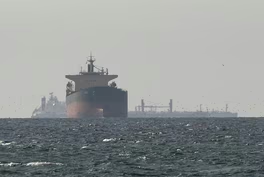
LEILA MOLANA-ALLEN: The roiling waters of the Persian Gulf further inflamed after Iranian missiles this morning struck three cargo ships, this one manned by the Thai navy, engulfed by fire, near one of the world's most critical oil passageways, the Strait of Hormuz, which snakes between Iran and the Arabian Peninsula.
Maritime groups say, in all, Iran has struck at least a dozen vessels there, effectively bringing traffic to a halt and global energy fears to an all-time high.
Today, Iran pledged it won't hold back.
LT.
COL.
EBRAHIM ZOLFAGHARI, Iranian Military Spokesperson (through translator): We will never allow even a single liter of oil to pass through the Strait of Hormuz for the benefit of the United States, the Zionists or their partners.
Any vessel whose ship or oil cargo belongs to them will be considered a legitimate target.
LEILA MOLANA-ALLEN: The situation has caused energy prices around the world to skyrocket, to offset the surge, an unprecedented response from the International Energy Agency, which announced it would release 400 million barrels of oil from its emergency stocks.
That's roughly 20 days' worth of the strait's exports, making it the largest distribution of reserves in history.
IEA Director Fatih Birol: FATIH BIROL, Executive Director, International Energy Agency: This is a major action aiming to alleviate the immediate impacts of the disruption in markets.
But, to be clear, the most important thing for a return to stable flows of oil and gas is the resumption of transit through the Strait of Hormuz.
LEILA MOLANA-ALLEN: It all comes amid fears that Iran is preparing to mine the Strait of Hormuz in an effort to shut down shipping altogether.
Leaving the White House today, the president said U.S.
oil companies should proceed with using the strait and reiterated to reporters what he told Axios, that there's -- quote -- "practically nothing left to target in Iran."
DONALD TRUMP, President of the United States: They have lost their navy.
They have lost their air force.
They have no anti-aircraft apparatus at all.
They have no radar.
Their leaders are gone.
And we could do a lot worse.
LEILA MOLANA-ALLEN: Still, joint U.S.-Israeli attacks continue across Iran, this explosion sending shockwaves through the northwestern city of Tabriz.
And, in the capital, bombs gutted neighborhood shops like this one.
A new Israeli intelligence assessment revealed that Iran's newly installed supreme leader, Mojtaba Khamenei, was lightly wounded at the start of the war.
Israel's defense minister today vowed to carry on for as long as it takes.
ISRAEL KATZ, Israeli Defense Minister (through translator): We will continue to act and crush this regime and its strategic objectives in Tehran and throughout Iran day after day.
LEILA MOLANA-ALLEN: Israel's campaign against Iran includes strikes on Hezbollah, the Iran-backed proxy group in Lebanon.
There, attacks ramped up beyond Hezbollah strongholds in Beirut's southern suburbs today, and continued to hammer Southern Lebanon.
So far, well over 500 have been killed and some 700,000 displaced.
MARIAM HASSAN RIDA, Displaced Lebanese (through translator): I want to go back to my hometown.
I'm afraid.
I'm scared for myself.
There are strikes here and there are strikes there.
I'm confused about where to go.
(SIRENS BLARING) LEILA MOLANA-ALLEN: And Iran's counterattacks have escalated to what its Islamic Revolutionary Guard Corps called today the most intense yet.
Missile remnants lay scattered in Central Israel after Iran said it's increasing its use of custom munitions against them.
Eyewitness video captured the moment an oil depot in Oman blew up after it was struck by an Iranian drone.
Oman had been the chief mediator between the U.S.
and Iran before the U.S.
and Israel launched the war.
And two drones fell near Dubai International airport, one of the world's busiest, continuing Iran's strategy of destabilizing its Gulf neighbors and energy markets.
Here in Qatar, Iranian attacks ramped up too, with multiple incoming missile and drone launches intercepted throughout the day.
A Foreign Ministry spokesperson for the country, which was previously a key neutral negotiator between Iran, the United States and Israel, said Qatar reserved the right to defend itself if necessary and had no plans to reconsider its strategic alliance with the United States over Iranian attacks on U.S.
bases in the region, but affirmed its belief that the only way this conflict will come to an end is via diplomatic means and urged all parties to come to the negotiating table to avoid any further escalation.
For the "PBS News Hour," I'm Leila Molana-Allen in Doha, Qatar.
Can tapping into oil reserves help stabilize prices?
Video has Closed Captions
Can tapping into oil reserves help stabilize prices? (6m 17s)

Group turns line dancing into therapy for grief and trauma
Video has Closed Captions
Miami group turns line dancing into therapy for grief and trauma (3m 25s)
How Trump's SAVE America Act would reshape voting
Video has Closed Captions
How Trump's SAVE America Act would reshape voting (6m)

How Ukraine is helping the U.S. defend against Iran's drones
Video has Closed Captions
How Ukraine is helping the U.S. defend against Iran's drone attacks (5m 38s)

Immigration crackdown sparks fear in people legally in U.S.
Video has Closed Captions
Minnesota immigration crackdown continues to spark fear among people in U.S. legally (7m 54s)
News Wrap: Tornadoes kill at least 2 in Indiana
Video has Closed Captions
News Wrap: Tornadoes kill at least 2 in Indiana (4m 51s)
Ukrainian troops share lessons on stopping Iran's drones
Video has Closed Captions
Ukrainian troops share lessons learned from fighting Iran's Shahed drones (5m 5s)
Providing Support for PBS.org
Learn Moreabout PBS online sponsorship
- News and Public Affairs

FRONTLINE is investigative journalism that questions, explains and changes our world.

- News and Public Affairs

Amanpour and Company features conversations with leaders and decision makers.












Support for PBS provided by:
Major corporate funding for the PBS News Hour is provided by BDO, BNSF, Consumer Cellular, American Cruise Lines, and Raymond James. Funding for the PBS NewsHour Weekend is provided by...